Jamaica Map
 Buy Printed Map
 Buy Digital Map
 Wall Maps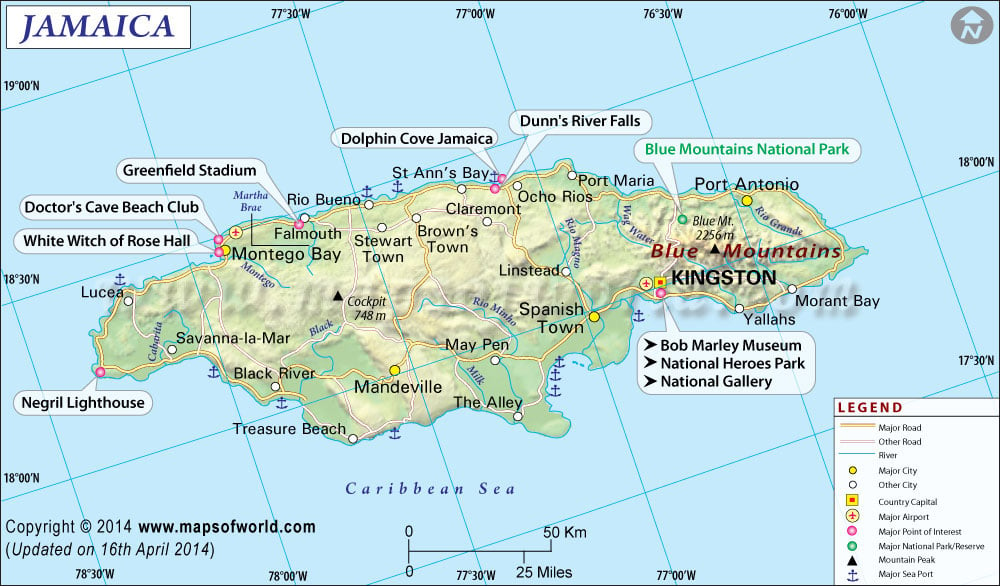
- Neighboring Countries - Haiti, Cuba, Dominican Republic
- Continent And Regions - North America Map, Americas Map
- Other Jamaica Maps - Where is Jamaica, Jamaica Blank Map, Jamaica Road Map, Jamaica Rail Map, Jamaica River Map, Jamaica Cities Map, Jamaica Political Map, Jamaica Physical Map, Jamaica Flag
About Jamaica
Explore this Jamaica map to learn everything you want to know about this country. Learn about Jamaica location on the world map, official symbol, flag, geography, climate, postal/area/zip codes, time zones, etc. Check out Jamaica history, significant states, provinces/districts, & cities, most popular travel destinations and attractions, the capital city’s location, facts and trivia, and many more.
| Official Name: | Jamaica |
| Capital: | Kingston |
| Population: | 2.6 million (2001) |
| Area: | 11,425 sq km or 4,411 sq mi |
| Currency: | Jamaica dollar ($1 = 45.55) |
| Religion: | Christianity |
| Literacy: | 85% |
| Languages: | English (official), Jamaican Creole |
| Major Cities: | Spanish Town, Portmore, Montego Bay, May Pen |
| Climate: | Tropical climate |
Jamaica is an island nation in the Caribbean Sea and has a of a population of over 2,847,200 (as of 2010). Just about 53% of the Jamaican population lives in cities and urban areas such as Kingston, Spanish Town, Portmore, and Montego Bay. Most of the Jamaican towns are overpopulated villages where the population is seldom more than a few thousands. The ethnic composition of Jamaica is surprising given the history of the country. Over 91% Jamaicans are black people of African descent. About 62% Jamaicans are Protestants and over 20% do not subscribe to any form of religion. English is the country’s official language and is the commonly spoken language in the island state. The locals, however, converse in a language popularly known as the Patois or Patwa. Patois is a form of native African modified heavily by English and Irish. Apart from this, at least 40% of the inhabitants of Jamaica speak and understand Spanish. Spanish is also taught in most Jamaican schools.
Jamaica is an active member of both the United Nations and the Commonwealth of Nations. The country is also a member of the G-77, IMF, Interpol, UN, UNESCO, WFTU, WHO, WMO, and the WTO. Jamaica maintains cordial international relations and hosts diplomatic missions of many countries.
History of Jamaica:
Arawak Country: Records show that the earliest settlers of Jamaica were South American natives who landed here as far back as 5000 BC. Cave dwellers with remarkable boat building skills, the Guanahatabey survived primarily by hunting and fishing. The Saladoids and later the Tainos colonized the island (in about 650 AD) and brought to the early Jamaican society an agrarian dimension. They grew maize, roots and spices, carved wood, fashioned beautiful pots and vessels and wove silk and cotton fabric. The Saladoid and Taino settlers, known as the Arawaks, practiced a pagan religion and worshiped natural elements such as the sun and the rain, spirits of the dead, and plants and animals. The Arawaks carved wooden idols of their deities and indulged in shamanistic rituals. An Arawak clique was typically headed by the chief or cacique. The Arawaks lived in thatched cane huts and painted their skins with natural dyes. Cassava was an important part of the Arawak diet and fermented maize and cassava alcohol were popular intoxicants. The Tainos had enslaved the earlier Saladoid settlers and a class based society existed in Jamaica by the time Columbus arrived. Christopher Columbus arrived in Jamaica in the year 1494 to find the island populated by 6 million Arawaks who had settled in over 200 villages. Columbus first tried to approach the island from the northern coast but the fierce Arawaks in war-canoes forced him to take a southern approach. After a minor skirmish, Columbus commanded the allegiance of the cacique and the Arawaks. Jamaica was claimed by Columbus for Spain. He returned to the island after exploring Cuba, later that year. Columbus’s return to Jamaica in 1503 on his last voyage to the New world was marked by a catastrophe. His ship sank off the coast of Jamaica and Columbus and his men were left stranded at Bahía Santa Gloria. Having been rescued by the efforts of his brave men, Columbus set off on a voyage home in 1504, never to return. The island was considered his personal property and bequeathed to his son upon his death in 1506.
Spanish Rule: The Spanish rulers subjected the native Arawaks to exploitative labor and cruel mistreatment. As a result the natives succumbed to neglect and disease and started to die. Almost the entire Arawak race was wiped out of the island excluding a handful of people who escaped to the mountainous terrain, now known as the Blue Mountains. The Spanish rulers started to bring in slaves from the rest of Africa and forced them to work on their Jamaican sugarcane plantations. Jamaica became the base for Spanish pirates who raided the ships that sailed on the waters of the Caribbean Sea.
English dominion: Lord Protector of England, Oliver Cromwell, assigned Admiral William Penn and General Robert Venables, the task of conquering the Caribbean islands for the British and establishing British supremacy over Spanish maritime trade. Fueled by their failure to capture Hispaniola, they changed course and embarked on a conquest of Jamaica instead. In May 1655, they landed in Jamaica with a fleet of 38 ships and 8000 troops. The Spanish troops offered token resistance under General Cristobal Ysassi. Most of the Spanish settlers fled to the north of the country and later, set sail to Cuba. By 1660, the Spanish protests were quelled by Colonel Edward D’Oyley in a battle at Rio Bueno and the British capital was set up at Spanish Town. The demand for Jamaican products such as sugarcane, cocoa, and coffee grew multifold in the following years and Jamaica was a profitable colony for the English.
Buccaneers: 17th century Jamaica saw an unexpected turn of events. The Buccaneers or pirates in the Caribbean coasts grew in numbers and were a force to reckon with. The British establishment guarded its colonies in the Caribbean by sponsoring the Buccaneers to raid Spanish, Dutch, and French ships in the vicinity. Sir Thomas Modyford’s alliance with the buccaneers led to the extensive use of Port Royal and Kingston Harbor by these pirates. The piracy of the Buccaneers caused huge damages, irrespective of nationality. Besides, with most of Port Royal destroyed by an earthquake in 1692, the British eventually decided to curb the terror wrought by the buccaneers.
Slave trade and revolts: The 17th century also saw a boom in slave trade in the country. Slaves from West African tribes were captured and transported (often under inhuman conditions) to Jamaica where they were sold and subjected to unrelenting labor in the plantations and households. Slave rebellion started in the year 1690. Aided by the Maroons (escaped slaves who had set up independent settlements), the slaves protested and rebelled against the brutish conditions they were subject to. The Maroon Wars saw full-fledged warfare of the British against the maroons and ended with the peace treaties signed in 1739 and 1740. Sugarcane production grew in Jamaica in the 18th century and the success of the enterprise may be estimated by the fact that plantation owners formed a powerful political lobby in England. By the year 1800, there were over 300,000 slaves in the country who were controlled by the extensive use of force. By Christmas in 1831, the atrocities of the plantation owners had peaked and the slaves broke out in mass protests and rebellion, with encouragement from Samuel Sharpe. By the year 1834, England recognized the need to address the issue. Slavery was abolished after much outcry and Jamaica embarked on the path to becoming a wage labor based economy. Despite being free, the erstwhile slaves faced harsh conditions such as low wages and class bias. Large-scale unrest resulted in the Morant Bay Rebellion of 1865. Paul Bogle spearheaded the movement which was repressed cruelly. Kingston emerged as the new capital in 1872, having outgrown Spanish Town in importance.
Independence: Decline in the sugarcane trade made the export of bananas significant and profitable for Jamaica. Banana plantations sprung up and the natural beauty of the island attracted tourists. In 1866, Jamaica was once again annexed and colonized by the British. The semblance of peace that ensued was short-lived. The Great Depression that swept across the world resulted in a plunge in sugar and banana exports. Jamaican economy was, predictably, affected adversely. The island once again saw widespread protests and demonstrations. Alexander Bustamante emerged as a leader of the masses and set up the BITU (Bustamante Industrial Trade Union) in 1938. The JLP (Jamaica Labour Party) was set up in 1943. Jamaica’s very first political party, the PNP (People’s National Party) was also set up in the same year. Increased political and economic awareness resulted in the nation’s demand for adult suffrage and a constitution. Jamaica was granted both in 1944.
Free Jamaica: On August 6, 1962, Jamaica saw the Union Jack replaced by the country’s new flag and tasted independence with Alexander Bustamante as the first Prime Minister. Post independence, Jamaica has faced a difficult era of turbulence and economic crisis. With crime and illiteracy coming up as the major deterrents in the growth of the country, natural calamities, such as the Hurricane Ivan in 2004, have inhibited the development of infrastructure in the country. Tourism and agriculture remain the most productive industries of Jamaica. The government has made sustained efforts to promote industrialization and to curb migration from Jamaica.
Geography of Jamaica:
Located in the Caribbean Sea, south of Cuba and west of Haiti, Jamaica encompasses a total area of 10,991 square kilometers including 10,831 square kilometers of land area and about 160 square kilometers of water. The 1,022 km long coastline is spotted with many beautiful bays and beaches making Jamaica an incredibly bountiful island that attracts tourists from across the world. The land is rich in bauxite, gypsum, and limestone ores. Most of Jamaica is rugged and mountainous, the highest area being the Blue Mountains region, to the east of the island. The Central Range and the Port Royal Mountains make the Blue Mountains the wildest and most beautiful region, full of high peaks and cool terrains. These ranges grow some of the world’s best coffee beans and are home to a variety of beautiful bio-life. The John Crow Mountains to the northeast is the richest deposit of limestone in the country. The Dry Harbor Mountains and the Mocho Mountains located in the central part of the island mark the origins of many of the country’s rivers. Rivers such as the Black River, the Rio Cobre, the White River, the Rio Grande, and the Lethe crisscross the land and make the plateau and the coastal region fertile. The island of Jamaica was formed from volcanic activity in the Caribbean Sea many thousands of years ago. The metamorphic rocks led to the deposition of limestone and this in turn, led to the formation of karst. Cockpit Country, to the west of Jamaica, is one of the best examples of karst topography in the Caribbean. The region is also the country’s largest contiguous rainforest. While the rugged mountainous terrain gets rather cold in winters, the coastal regions of south Jamaica enjoy a warm, but humid climate. Jamaica is often hit by hurricanes from June to November. The country has faced extreme devastation by Hurricane Ivan, Hurricane Dennis, Hurricane Emily, and Hurricane Dean in recent years.
Although administratively a single unit, Jamaica is divided into 14 parishes. The parishes in Cornwall Country (west) are Hanover, Saint Elizabeth, Saint James, Trelawny, and Westmoreland; the parishes in Middlesex Country (center) are Clarendon, Manchester, Saint Ann, Saint Catherine, and Saint Mary; the parishes in Surrey County (east) are Kingston, Portland, Saint Andrew, and Saint Thomas.
Economy of Jamaica:
Jamaica’s economy is a service dependent economy. The country’s GDP is estimated to be $23.93 billion, as of 2010. Traditionally an agriculture dependent economy, Jamaica moved away from its reliance on sugarcane and banana export towards the export of bauxite-alumina. Jamaica is among the world’s largest producers of bauxite and alumina. The export of bauxite and alumina accounts for about 10% of the country’s GDP. For foreign exchange Jamaica depends heavily on its tourism industry and on the remittances of Jamaicans who have migrated to other countries. The tourism industry of Jamaica showed a positive growth in 2010.
Jamaica’s primary agricultural products include sugarcane, bananas, coffee, yams, and ackee fruits. Animal husbandry is an important industry in the country. Poultry, milk, cheese, and butter are produced aplenty but not enough to cover local demands. The export of sea fishes to USA and Canada is also a foreign exchange earner for the country. But the contribution of these exports to the GDP is negligible. Besides bauxite and alumina, Jamaica produces considerable quantities of limestone and marble as well. The country, however, lags behind in areas of industrial production. In 2010, Jamaica’s industrial production fell by about 2 %. A number of factors, including the very high crime and corruption rates, have contributed significantly to diminishing industry. Jamaican economy registered a GDP growth rate of -0.8% 2010. The country’s debt-to-GDP ratio is an alarming 123%. Inflation went up from 9.6% in 2009 to 13% in 2010. A rise in the unemployment scenario has fuelled an increase in criminal activities in Jamaica.
State and Polity of Jamaica:
As a Commonwealth country, Jamaica is a constitutional monarchy with Queen Elizabeth II as the current head of the state. The Queen is represented locally by a Governor General. All executive powers, however, are vested in the Prime Minister and his cabinet. Jamaican government is based on a parliamentary system of governance and the legislature is chosen by universal, adult suffrage making it a democracy. The Governor-General is appointed by the monarch with advice from the Prime Minister. The monarch also appoints the cabinet ministers with the consent of the Prime Minister. The Jamaica Independence Act was passed in the United Kingdom Parliament in 1962 and the act enforced the constitution of Jamaica. The parliament of Jamaica consists of two houses – the House of Representatives and the Senate. The members of the former are elected representatives of the people. The Governor-General uses his discretionary powers to appoint the Prime Minister from among the members of this house. The Prime Minister must command the confidence of a majority of the members of the House of Representatives. Members of the Senate are nominated both by the Prime Minister and the Leader of the Opposition. The judiciary of the country is independent of both the legislature and the executive in keeping with the ‘separation of powers’. In recent years Jamaica has moved from a bi-party system to a multi party system with National Democratic Movement (NDM) joining the political foray, traditionally held by the People’s National Party (PNP) and Jamaica Labour Party (JLP).
Crime: 1998 – 2000 UN data reveals that Jamaica is the country with the highest rate of murders after Colombia and South America. Instances of murder in Jamaica have been alarmingly high for many years now. Incidences of violence against the gay and lesbian community have also been high and are a major cause of concern among tourists and visitors. The country was named ‘the most homophobic place on earth’ by human right activities the world over. Allegations of Jamaican music inspiring anti gay and lesbian sentiments have lent popular reggae music the name “murder music”. Drug trafficking is one of the crimes Jamaica has been grappling with for a long time. The World Drug Report 2010, names Jamaica as a favorite destination for cocaine traffickers from South America. 2006 reports confirm that over 9.9% of the population of Jamaica was under the influence of cannabis addiction. The government’s anti drug stand and tightening security has led to a steady decline in drug dealings from 2000 through 2008. This has, however, negatively affected the murder rate in the country which stood at 59 per 100,000 in 2008. This is attributed to the loss of income of traffickers through narcotics leading to violence and other criminal activities. Corruption in Jamaica is high and has discouraged successful foreign investments in Jamaican enterprises. The government has also been grappling with money laundering activities and organized crimes as well.
Military: The combined military forces of Jamaica are called the Jamaica Defence Force. The Jamaica Defence Force or the JDF has Ground Forces, Coast Guards, and an Air Wing from the year 2010. The JDF recruits personnel aged 18 or above for voluntary military service. The country does not impose conscription on these servicemen. The JDF at times also recruits personnel between the ages of 16 and 18 with parental consent. Conscription is imposed on these personnel. About 0.6% of the national GDP is budgeted towards military spends. As with most Commonwealth countries, the JDF personnel are recruited and trained according to the British military model. Training assistance is provided by UK, Canada, and USA. The soldiers are provided basic military training in any of the training schools of UK or Canada. Senior officers are provided specialized training in these countries as well. The infantry regiment of the JDF is often called upon to assist the Jamaican police, Jamaica Constabulary Force (JCF), to curb the high incidences of crime and drug trafficking in the country. The Engineering Unit of the JDF actively supports the infantry, navy and air forces with engineering assistance. It is not unusual for the Engineering Unit to take on civilian assistance responsibilities as well in case reconstruction of bridges and other structures becomes necessary after a hurricane or other natural calamities, the Engineering Unit pitches in. Besides providing defence to the country, the Coast Guards are also required to act as a maritime law enforcement unit. Maritime safety and rescue missions are also undertaken by the Coast Guards of Jamaica. The JDF Air Wing also takes up rescue and training work in addition to the regular defence operations.
Jamaican Diaspora: At 5.52 emigrants per 1,000 citizens (as of 2010), Jamaican diaspora is among the highest in the world. Over a million native Jamaicans have moved out of their country and settled in countries such as UK, USA, Canada, other South American countries, Egypt, and even in neighboring Cuba. The country’s economic conditions and high rate of unemployment are major contributors to the high emigration rate. Besides, pursuing a successful career in a non-traditional field such as music is rather difficult. A number of gifted musicians, artists, and poets decide to leave the country every year. The traditional path followed by the Jamaican emigrants is to the United Kingdom and from there to other countries of the world. London is one of the cities with the highest Jamaican diaspora. Besides London, a high concentration of native Jamaicans is found in Leeds, Birmingham, Liverpool, Bristol and Sheffield. In the United States, a number of Jamaicans live in the cities of New York City, Washington, D.C., Los Angeles, Buffalo, Atlanta, Orlando, and Philadelphia. Toronto is the city with the highest Jamaican diaspora in Canada. Other countries that have recorded a significant number of immigrant Jamaicans are Australia, Indonesia, Malaysia and Singapore.
The emigrant Jamaicans have worked hard at preserving their native culture in these countries. The Notting Hill and Tottenham Carnivals in London record an impressive contribution of the Caribbean community, especially the Jamaican settlers. The Jamaican eateries, nightclubs and markets of Brooklyn are part of the Jamaican expatriate community’s attempt to recreate a home away from home. In Toronto, Jamaica Day is celebrated in July and the popular Jamaican reggae music has found many Canadian fans. Most of these countries are now home to second and third generation Jamaicans.
Jamaica Travel:
Norman Manley International Airport in Kingston, the Sangster International Airport in Montego Bay and the Ian Fleming International Airport in Ocho Rios are the three international airports that serve Jamaica. Air Jamaica is the national airline of the country and its fleet of Boeing and Airbus crafts connects Kingston and Montego Bay with Nassau in the Bahamas and Toronto in Canada, Fort Lauderdale, New York, and Philadelphia in the USA. Besides Air Jamaica, 9 other major airlines of the world operate from these airports. The island of Jamaica is has a good road network of over 18,700 kilometers or 11,620 miles. Jamaican Railways does not currently transport passengers. MapsofWorld brings you our recommendation of the 10 favorite tourist attractions in Jamaica. When in the country let your adventurous spirit take over and explore small villages and native settlements.
MapsofWorld recommends: 10 Jamaica attractions
Kingston: Kingston is the capital city of Jamaica and the largest city of the country in terms of population and area. Initially set up as an earthquake refugee center in 1692, Kingston’s affluence quickly overtook Spanish Town and in 1872, Sir John Peter Grant decided to move the Jamaican capital to Kingston from Spanish Town. The city is a shopper’s delight with a number of markets selling local handicrafts, clothes and pieces of bric-a-brac. The places to visit in Kingston are Devon House, Hope Gardens, the Bob Marley museum, Port Royal, Lime Cay and Rockfort mineral spa. Kingston is also the cosmopolitan hub of Jamaica and you are more likely to find more restaurants serving international cuisine in Kingston than elsewhere in Jamaica.
Montego Bay: Sir Donald Sangster International Airport in Montego Bay is Jamaica’s largest airport. While at Montego Bay, be sure to explore Doctor’s Cave Beach, Aquasol Beach Club, and Cornwall Beach. The St James Parish Church, downtown, is over 200 years old and has some interesting sculptures. The National Heroes Monument, Creek Dome and Sam Sharpe Square are other places you must see in Montego Bay. The Montego Bay Civic Centre is witness to some of the important events of Jamaica’s history including the trial of Samuel Sharpe and his eventual execution at the square. The Center has now been converted to a museum and a theater.
Negril: The beach resort of Negril is located in the western fringes of the country. Long Bay Beach, Kool Runnings Water Park, Rick’s Cafe, and Royal Palm Reserve are among the well known tourist attractions of Negril. Long Bay Beach is ideal for enjoying a warm sunny day, playing beach sports and joining jazz parties. Rick’s Café is the ideal place to meet the locals, taste local food, and pursue some adventure. Swinging cabarets, reggae parties, live bands, and the vibrant nightlife of Jamaica is best experienced in Negril. Negril offers a lot by way of adventure and water sports and is also good for some duty free shopping.
Ocho Rios: Located in the Saint Ann parish of Jamaica, Ocho Rios was once a fishing hamlet but is now a popular tourist destination in the country. Tourists enjoy climbing the rock surface along the Dunn’s River Falls near Ocho Rios. Dolpin Cove is ideal if you wish to spend a day with dolphins, sharks and stingrays. Experience of kayaking at the Ocho Rios resort is guaranteed to leave you asking for more. Reggae Xplosion is a museum that is dedicated to all forms of Jamaican music including Reggae, Dancehall, Ska and Dub. The Wassi art museum has a very colorful display of pots and local artwork.
Port Antonio: Capital of the Portland parish, Port Antonio, is one a major tourist attraction in Jamaica. The Blue Lagoon in Port Antonio was believed by the natives to be bottomless. It is an idyllic retreat that provides boating opportunities. A dip in the blue waters and rest in the warm sands of the beach at Frenchman’s Cove is the best way of spending an afternoon at Port Antonio. The seaside eateries serve excellent native food. While the village of St. George in Port Antonio is ideal for tourists intending to buy books and high-style clothes, Musgrave Market is your destination if you are looking to sample some local food and buy trinkets.
Pelican Bar: Pelican Bar is quite a unique experience and getting there is an adventure by itself. A 20 minute ferry ride from Treasure Beach, Pelican Bar is just as easily accessible from Black River as well. The wooden shack built on a sand bar in the sea offers sunbathing and fishing activities – exactly what the tourists on a leisurely vacation require. Pelican Bar is owned by Floyd Forbes, a local fisherman. The sandbar was named after the pelicans that flock here through the day.
Runaway Bay: Runaway Bay, as the name suggests offers a unique opportunity to escape the bustling cities and retreat to the tranquil white sand beaches. Located between St. Ann’s Bay and Discovery Bay has a range of water sports on offer. Scuba diving and golf are the popular activities available here. Nearby points of interest include the Seville Heritage Park, the Green Grotto Caves and the Cranbook Flower Forest. Runaway Bay is a short distance from Ocho Rios and Montego Bay, and car rentals in both towns make it easy to reach the resort.
Black River: The township of Black River is significant in the history of the St Elizabeth parish of Jamaica. In 1999, part of the town was designated Protected National Heritage District. Home to Jamaican national heroes such as George William Gordon and Norman Washington Manley, the town is known for its beautiful architecture. The Black River or Rio Caobana gets it name from the dark soil of the river bed. Black River crocodile safaris are probably the greatest attraction of the town. Over 300 crocodiles are believed to inhabit the river. Local boatmen are often willing to take tourists to the Black River Lower Morass.
Blue Mountains: The Blue Mountains in eastern Jamaica are certainly not for the faint-hearted. Adventure lovers like the Blue Mountains due to the wilderness, the rugged trails and the great hiking opportunities it offers. The Blue Mountain Peak, at 2256 m is known for its stunning views. The Blue Mountain coffee plantations produce one of the best coffees in the world. Holywell, Whitfield Hall, and Newcastle are places of interest to tourists. The Blue Mountains are great for ornithology as a number of tropical birds can be sighted here.
Spanish Town: Located in St. Catherine Parish, Spanish Town was established as the capital of Jamaica in 1534. The city’s architecture reflects the Spanish influence and a visit to the city’s attractions such as Rodney Memorial, Kings Memorial, and the House of Assembly are a walk through the history of the city. Spanish Town continued as the capital of Jamaica under the British dominion till the year 1872. By this time, Kingston has outgrown Spanish Town in population and affluence and Sir John Peter Grant decided to establish Kingston as the new capital. Spanish Town is currently the third most populous city in Jamaica.
Life in Jamaica is never dull. The passion of the natives, the fiery food, the hip music, the stunning beaches and the infectious gaiety make the country an experience to be cherished.
Sports in Jamaica:
Sport is an important part of Jamaican life. Education in the country is designed to encourage sports and athletics. The West Indies cricket team has had many Jamaican team members including Courtney Walsh, Michael Holding, and Collie Smith. Another celebrity cricketer from Jamaica is George Headley. Football is the sport popularly followed in the country and has a huge fan following. The Jamaican National Football Team has won the Caribbean Cup five times including their recent 2010 cup. Other sports played in Jamaica include rugby, netball & field hockey, basketball, and boxing. The country has a very strong Bobsleigh team as well.
Jamaican Food:
Jamaican food is influenced by the many centuries of colonial rule. Traditional Jamaican cuisine is a simple and nutritious medley of locally available fruits and vegetables. Local preparations use colorful vegetables including ackee, avacado, banana, breadfruit, cabbage, callaloo, cassava, coco, coconut, peas, pepper, and sweet potato. Vegetables are salted and picked or stewed. Spices used extensively in Jamaican food include cardamom, cinnamon, nutmeg, cloves, and pepper. Vegetarianism is on the rise in the island and a number of restaurants serve vegetarian and vegan food. Beef, chicken, pork and a number of fishes including saltfish, grouper and carite, cod, and snapper are commonly consumed in Jamaica.
Of the cooking techniques used by Jamaicans, ‘Jerk’ is probably the most popular. Jerk is the process of marinating meat such as pork and chicken. Jerk seasoning is a blend of spices such as cloves, cinnamon, garlic, nutmeg, thyme, and scallions with allspice, a dried berry that is grown in Jamaica. Meat may be dry rubbed with the Jerk seasoning or marinated in it and slow roasted. Escovitch is another famous Jamaican style of cooking adopted from the early Spanish inhabitants. Fish is cooked in spices with a strong blend of onions and vinegar. Escovitch Fish is an absolute favorite with the natives. Fishes are usually salted by the fishermen to preserve them better and by the merchants to increase shelf life. Festival is a bread that is commonly eaten in Jamaica and roasted breadfruit is used as a substitute to bread. Rice consumption among native Jamaicans is high. Jamaicans commonly enjoy eating different kinds of patties. The ubiquitous patty may have a sweet fruit filling or may be filled with meat and even vegetables. Every Jamaican town is certain to have a patty shop the locals swear by.
The use of coconut and fruit purees gives most dishes a sweet tang. Ackee rice and salt fish is often referred to as the national dish of Jamaica. Ackee needs careful preparation. The unripe fruit is known to cause hypoglycemia. Kidney beans, red beans and peas are commonly used in most recipes. Jamaica is also known to produce excellent white rum.
A peanut porridge, ackee and saltfish, boiled bananas and yams make for a filling breakfast with the native. A midday snack of Irish Moss (a stimulating drink) or Guinness Stout Punch and Ackee and Salt fish Patty with pureed an sweetened Sorrel is easily available in the many quaint cafes of Jamaican cities. For a traditional lunch you might want to order cowcod or pumpkin soup, coco bread, jerk pork, steamed rice, plantain fritters and Gizzada. A dinner of rice and peas, boiled yams and escovitch fish, duckanoo, pineapple avocado salad and coconut water remains a gourmet’s delight. In Jamaica do not forget to try the Blue Mountain coffee.
MapsofWorld Trivia: “Ackee rice, salt fish are nice/And the rum is fine any time-a-year” The lyrics of ‘Jamaica Farewell’ beautifully captures the essence of Jamaican cuisine. The song, immortalized in Harry Belafonte’s album, ‘Calypso’, is a worldwide hit and featured high in Billboard Hot 100 for a long time. The song was also sung by Jimmy Buffett, Chuck Berry, Marty Robbins, and Pat Rolle. When Belafonte croons, “I must declare/My heart is there…” most tourists agree.
Jamaican Culture:
Music: Bob Marley, Shaggy, Sean Paul, Beenie Man, and Luciano are some of the best known names in the world of rap, reggae, and dancehall. Jamaican music also includes a variety of popular music such as jazz, mentos and even folk music.
Bob Marley and his troupe, the Wailers immortalized reggae music. Marley was awarded many honors including the Grammy Lifetime Achievement Award in 2001 and the Peace Medal of the Third World from the United Nations in 1978.
The oldest genre of music on the island is folk music. Folk music has survived and evolved with the nation itself. The country’s folk music has been fiercely preserved by the natives as part of their culture. Mento music in the country popularized the use of traditional instruments such as the banjo and drums. Though similar to Trinidadian calypso, mento music found very little audience outside the island. Ska shot to fame in the mid 20th century to be soon followed by rockstead and reggae. Dub, dancehall, and raaga became popular towards the end of the 20th century and the popularity of these music forms spread across the globe. Jazz found patronage in Jamaica in the early part of the 20th century and till date remains the favorite form of music in the country. Many Jamaicans jazz musicians have made successful careers for themselves in the UK and in the USA. Bertie King, Wilton Gaynair, Joe Harriott are among the world’s best saxophonists who come from Jamaica.
Arts and Literature: The native Arawak art forms have been preserved well in Jamaica, owing partly to the increased interest of tourists in traditional art. Wassi pottery is the perfect example of folk art survival in the island. The bold use of vegetable colors, the simple designs and the rustic themes make these terra-cotta ware great souvenirs to bring back from Jamaica. Wood and coconut carving is another folk art form practiced to perfection in Jamaica. Painting and jewelry making are common household enterprises. When in Jamaica you may expect to buy inexpensive beads and metal jewelry in the local marketplaces. The origins of Jamaican literature can be traced back to Arawak folklore. Thomas Mac Dermot is often known as the father of Jamaican literature. The country’s poets and authors have used the dialects of the land to express native sentiments.
MapsofWorld Trivia: Bob Marley, the famous singer-lyricist popularized Reggae music across the world. ‘Legends’ his compilation was released posthumously in 1984 and sold over 20 million copies worldwide. Marley is now being considered for the Order of National Hero, Jamaica’s highest honor.
“Our union must know no clime, boundary, or nationality…let us hold together under all climes and in every country…” Jamaican journalist and orator, Marcus Garvey’s immortal words sum up the spirit of Jamaica. An incredibly beautiful country with a very colorful culture and warm-hearted people, Jamaica, is a traveler’s dream-come-true.