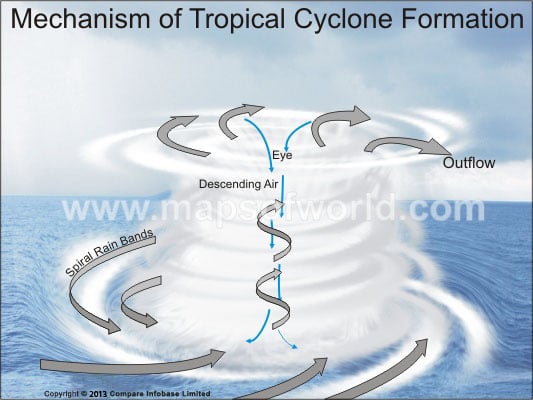
Tropical cyclones are a type of storm that forms over oceans in tropical regions, and are characterized by heavy rain and wind. A cyclone is a low atmospheric pressure zone where wind flows in a spiral pattern, which spins counterclockwise in the Northern Hemisphere and clockwise in the Southern Hemisphere. The eye or core of the cyclone is usually calm and warm.
Tropical cyclones are “warm core” storm systems, powered by enthalpy of condensation of high moisture air, which condense at higher altitudes. Tropical cyclones are characterized by the release of latent heat of condensation of moist air. Tropical cyclone formation can be visualized as a gigantic vertical heat engine powered by Earth’s gravity and rotation. The condensation is absorbed by air at high altitudes, and this system continues to sustain itself until the energy supply is stopped. Condensation creates higher wind speeds, which pushes the cycle of storm to continue in a positive feedback loop. Once cyclones reach land, or even when they reach cold water, they typically dissipate because they lack the condensation needed to continue.
Hurricanes and typhoons are both categories of intense tropical cyclones. Typhoons are tropical cyclones that occur in the Northwest Pacific, while hurricanes occur in the North Atlantic a Northeast Pacific.