Chile Map
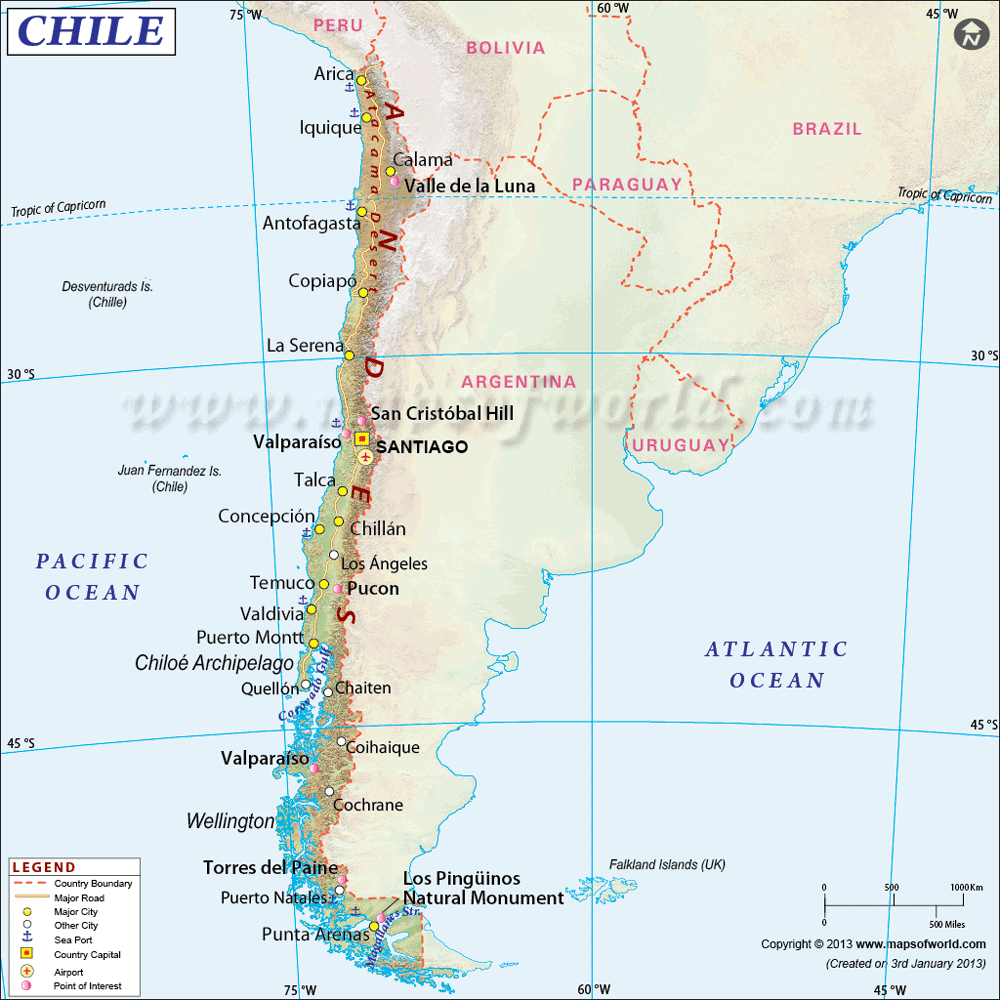
- Chile Regions - Antofagasta, Araucania, Arica y Parinacota, Atacama, Aysen, Biobio, Coquimbo, Los Lagos, Los Rios, Magallanes y de la Antartica Chilena, Maule Region, O'Higgins, Santiago Metropolitan Region, Tarapaca, Valparaiso
- Neighboring Countries - Argentina, Bolivia, Peru
- Continent And Regions - South America, Americas
- Other Chile Maps - Where is Chile, Chile Blank Map, Chile Political Map, Chile Railway Map, Chile Road Map, Chile Physical Map, Chile Flag
About Chile
Explore this Chile map to learn everything you want to know about this country. Learn about Chile location on the world map, official symbol, flag, geography, climate, postal/area/zip codes, time zones, etc. Check out Chile history, significant states, provinces/districts, & cities, most popular travel destinations and attractions, the capital city’s location, facts and trivia, and many more.
| Official Name : | (Republic of Chile) Republica de Chile |
| Capital : | Santiago |
| Population : | 15.4 million |
| Area : | 757,626 sq km or 29,2521 sq mi |
| Currency: | Peso ($1=537.86) |
| Religion: | Christianity |
| Literacy: | 95% |
| Languages: | Spanish |
| Major Cities: | Santiago, Valparaiso |
| Climate: | Varied climate |
Chile, originally a Spanish colony, became independent in the year 1810. The country is rich in mineral resources and today figures among the leading exporter of copper.
Physical Map of Chile
The dominant physical feature of Chile is the Andes Mountains, which extend the entire length of the country, from the Bolivian plateau in the north to Tierra del Fuego in the south. Actually, the country can be divided longitudinally into three topographic zones – the lofty Andean cordillera on the east; the low coastal mountains on the west; and the plateau area, which includes the Central Valley, between these ranges. As per latitude, it can be divided into three geographical and climatic regions – the northern, central and southern regions. Many rivers flow through Chile and most of them are relatively short, generally rising in the Andes and flowing west to the Pacific.
Location of Chile
Chile is bound on the north by Peru, on the east by Bolivia and Argentina, and on the south and west by the Pacific Ocean. It has an extreme northern-southern length of approximately 4,270 km, but its average width is less than 180 km.
Flora And Fauna of Chile
The northern region, which is very dry and a desert region, has vegetation such as brambles and cacti. The Central Valley is more humid and supports several species of cacti, espino, grasses, and the Chilean pine, which bears edible nuts.
Dense rain forests are located south of Valdivia with laurel, magnolia, false beech, and various species of conifers. In the extreme south, a steppe vegetation of grasses is found.
Animal life is made up of mammals like llama, alpaca, vicuna, guanaco, puma, Andean wolf, huemal (a large deer), pudu (a small deer), and the chinchilla. Birds of different variety are also found and apart from trout, the lakes of Chile have few freshwater fish. However, the coastal waters have abundance of fish and marine animals.
Chile experiences varied climates. Winters are mild, and summers are relatively cool. Rainfall generally occurs in the winter months, i.e., from May to August. The northern region is almost entirely a desert and is one of the driest areas in the world.
People of Chile
The population of Chile is made up of Mestizos, persons of mixed Spanish and Native American ancestry, who make up for 93 percent of the current population. Only 3 percent consists of pure Native American, mainly Araucanians who are concentrated in the southern region; and the other 2 percent of the population is made up of unmixed European race. Most of the population lives in urban centers, and more than one-third of the people live in the capital city of Santiago. Communities both in the south and in the northern desert are generally isolated and separated by vast, virtually unpopulated stretches.
Arts, Culture and Music of Chile
The country of Chile has two lively and contrasting cultures: the cosmopolitan culture of the affluent urban population, and the popular culture of the peasants, which is mainly Spanish but contains traces of Araucanian heritage. The culture of peasants is heavily reflected in their music and dance. The country also has a flourishing literary tradition and has produced two Nobel Prize winners in literature, Gabriela Mistral and Pablo Neruda, both poets.
Flag of Chile
The flag of Chile has two equal horizontal bands of white, at the top and red. There is a blue square, the same height as the white band at the hoist-side end of the white band. The square bears a white five-pointed star in the center representing a guide to progress and honor. The blue symbolizes the sky, white is for the snow-covered Andes, and red stands for the blood spilled to achieve independence. This design was influenced by the US flag.
Economy of Chile
Chile is one of the leading industrial nations in Latin America as well as one of its largest mineral producers and is also known for its fruit and wine production. Since the early 20th century, production of copper has dominated the Chilean economy. In the beginning of 1940s, the government worked to diversify the economy, rapidly expanding the industrial sector. But after the military coup in 1973, the government played a less prominent role in the economy. It also made efforts to improve the neglected agricultural sector and to reduce the country’s dependence on imported food.
In 2000 the national budget had $16.7 billion in revenues and $16.5 billion in expenditures. Chile’s estimated gross domestic product (GDP) in 2001 was $66.5 billion.