Mali Map
 Buy Printed Map
 Buy Digital Map
 Wall Maps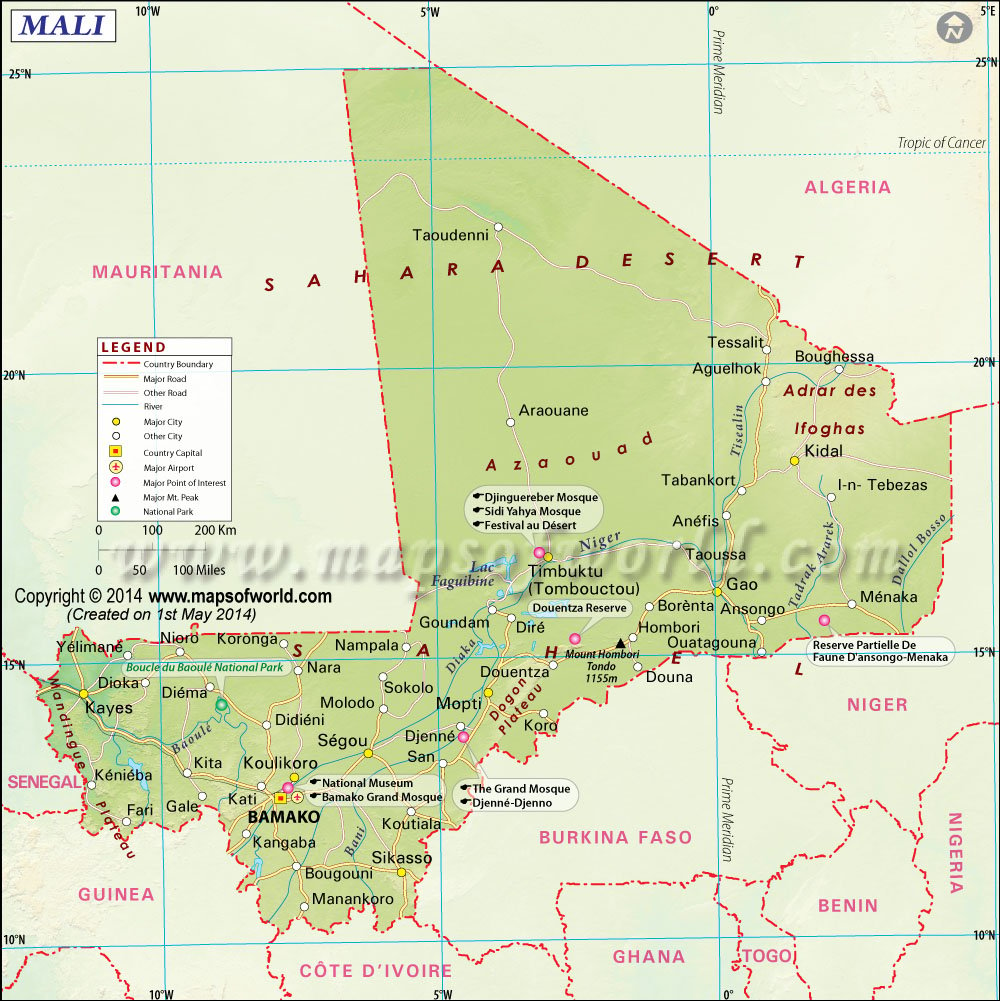
- Neighboring Countries - Algeria, Niger, Burkina Faso, Guinea, Senegal
- Continent And Regions - Africa Map
- Other Mali Maps - Where is Mali, Mali Blank Map, Mali Road Map, Mali Rail Map, Mali River Map, Mali Cities Map, Mali Physical Map, Mali Flag
About Mali
Explore this Mali map to learn everything you want to know about this country. Learn about Mali location on the world map, official symbol, flag, geography, climate, postal/area/zip codes, time zones, etc. Check out Mali history, significant states, provinces/districts, & cities, most popular travel destinations and attractions, the capital city’s location, facts and trivia, and many more.
| Full name: | Republic of Mali |
| Capital City: | Bamako |
| Language: | French, Bambara, Songhai, Arabic |
| Currency: | West African CFA Franc |
| Religion: | Muslim, traditional African religion, Christian |
| National Anthem: | “Pour l’Afrique et pour toi, Mali” that can be interpreted as “For Africa and for You, Mali”. |
| Newspaper: | Info Matin, Le Republicain, Les Echos, L’Essor |
| Places to Visit: | Bamako, Bamako, Djenné’s Monday Mosque Market, Dyingerey Ber Mosque, Musée National and many other beautiful places are there in Mali. |
| Transport: | Airways: Point Afrique between major cities in Mali. Roadways: since the country is landlocked, buses and taxis are available through out the country. |
| Shopping: | Traditional crafts; masks from the tribes such as dogon, bambara and malinko; woodcarvings; ebony carvings; woven cloth; bronze wares; mats; pottery; jewelry made of gold, silver and copper; copperwares; iron-wares like swords, daggers apart from traditional vessels. |
Republic of Mali is a non-coastal state located in the Western Africa. The country Mali was previously two separate states known as the Sudanese Republic and Senegal. Then in the year of 1960, these two states regained their independence and together they formed the individual nation Mali
LOCATION OF MALI
Republic of Mali is a country is located in the western region of the African continent. It is a landlocked country.
The neighboring states that share their borders with Mali are Algeria in the northern region, Niger in the eastern region, Burkina Faso and Côte d’Ivoire together in the southern side, Guinea in south-western region and Senegal and Mauritania to the western area.
PHYSICAL MAP OF MALI
Mali ranks second to Nigeria regarding size. The northern region of the country is mountainous. Otherwise the country is characterized by the plain lands. The northern portion of the country is known as Sagaran region. On the other hand the southern region is known as Sudaneseand the center of the country is known as the Sahelian region.
In the southern part of the country the rivers Niger and Senegal flow. The highest altitude of the nation is claimed by the Hombori Tondo peak that rises up to 1,155 meter above the sea level. On the other hand the lowest altitude is claimed by the river Senegal. It goes down up to 23 meter below the sea.
FLAG OF MALI
The flag of Mali is very simple. It has a rectangular shape. The flag is divided in three vertical bands. The hoist side band is colored in green. The middle of band is yellow and the fly side of the flag is red. All the bands are of same size. A flag of a country has their significance and individuality. It bears the nations prestige. The colors of the flag also symbolize some meaning. In the flag of Mali the color green symbolizes fertility and agriculture. Red is a symbol of bloodshed and vigor. These colors are the pan-African colors of Ethiopia.
CLIMATE OF MALI
Gather some details bout the climate of the country you are planning to visit. You should know which the best time to visit he place is. The climate of Mali can be termed as subtropical. During the months between June and November the weather remains wet and gentle. Rainfall occurs time to time. On the other hand the months between February and June the weather remains hot and arid. If you want too visit Mali during its winter season, you must visit the county during the months between, November and February
Flora And Fauna Of Mali
- Flora: In Mali a major portion is under the climactic influence of the Sahara desert. So naturally those areas are characterized by the cactus plants such as mimosas and gum trees. The Sahelian region is also similar and has only plants with thick leaves and thorns. Shrubby savannas can also be found in those regions. Mahogany, baobab, shea, kapok etc are found in the Sudanese region of the country. Some other agricultural crops are millet, rice, cotton, corn, peanuts etc are also there.
- Fauna: Similarly the animal world of the country is also characterized by the climactic features of the desert. The animals that can be found in the mountainous areas are cheetah, dorcas, wild sheep, cattle, goats and so on. You will also get to see various other species of wild animals such as gazelle, giraffe, oryx, wart hog, bustard, red monkey, jackal, ostrich, cheetah, lion, fox, cynhyena, hyena and some other kinds. In the Sahelian area you can also find some unique species of antelopes, elephant, buffalo, monkey etc.
People Of Mali
The total population of the country Mali is 11,716,829. Diverse ethnic groups reside in this country. Various tribes, castes and races along with different regions exist together in this country.
However the Mande people rule the major part of the total population in Mali. These Mande people originally belong to the Bambara, Malinke, Soninke groups. The other members of the minority are Peul, Voltaic, Songhai, Tuareg and Moor. There are total thirty-two languages that are spoken in the country. However French the language that is mostly spoken. Bambara is also spoken throughout the country.
Art, Culture And Music Of Mali
• Art: Djembe Drum, Talking Drum, Beautifully handmade instrument like Balafon Medium and some local handicrafts are popular in the country. Beside that Brass Carvings, Wood Carvings, Fabric & Clothing, Jewellery, Wicker Baskets can also be found in the various regions of the Mali.
• Culture: Since there are various religions and tribes and castes present in the country Mali, the culture is very rich and diverse. Several forms of music and dance have come various sections of the people. Festivals of different regions have also been accepted in the country. Some musical, religous, cultural and harvest festivals are practiced through the put the African continent and also in the country Mali.
• Music: The Mande people cover the major portion of population in Mali. So the Mande Empire has a heavy influence on the music of the country. The folk music is practiced in Mali and beside that some other forms of music has also emerged. Some of the Mande music forms are Bamana, Mandinka, Maninka etc.
Economy Of Mali
Mali is a very poor country not only on Africa, but also in the whole world. Most of the inhabitants are dependent on farming and fishing. The few industries that are growing in the country are also based on farm goods. Pottery is another source of income for the people of Mexico. It is also a source of revenue to the country. Cotton can be said to be the only export commodity of this country. So it highly depends on the production of cotton. It also has to depend on the economic assistance from the foreign countries.