Pakistan Map
 Buy Printed Map
 Buy Digital Map
 Wall Maps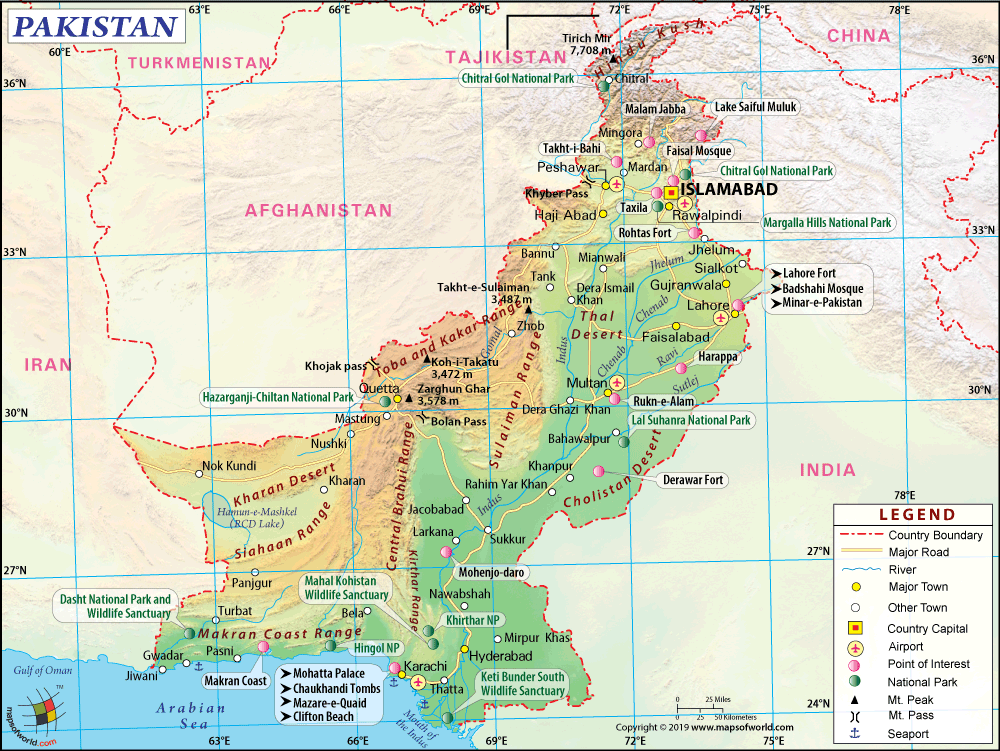
- Pakistan Cities - Islamabad, Karachi
- Neighboring Countries - Afghanistan, India, China, Tajikistan, Iran
- Continent And Regions - Asia Map
- Other Pakistan Maps - Where is Pakistan, Pakistan Blank Map, Pakistan Road Map, Pakistan Rail Map, Pakistan River Map, Pakistan Political Map, Pakistan Physical Map, Pakistan Flag
About Pakistan
Explore this Pakistan map to learn everything you want to know about this country. Learn about Pakistan location on the world map, official symbol, flag, geography, climate, postal/area/zip codes, time zones, etc. Check out Pakistan history, significant states, provinces/districts, & cities, most popular travel destinations and attractions, the capital city’s location, facts and trivia, and many more.
| Official Name | (Islamic Republic of Pakistan) Islam-I-Jamhuriya-e-Pakistan |
| Capital | Islamabad |
| Population | 145 million |
| Area | 796,095 sq km or 307,373 sq mi |
| Currency | Rupees |
| Religion | Islam |
| Literacy | 38% |
| Languages | Urudu, Punjabi, Sindhi, Pushtu, Baluchi, Brahvi, English |
| Major Cities | Islamabad, Karachi, Lahore, Peshawar |
| Climate | Varied climate |
South-Asia, Pakistan was the cradle of the earliest known civilization, the Indus Valley civilization. The country formed part of the Mughal Empire from 1526 to the 1700s, when British took over it.
The rivers and coastal waters contain numerous freshwater and saltwater fish, including herring, mackerel, sharks, and shellfish.
Apart from this, endangered species like the snow leopard, Marco Polo sheep, blue sheep, and ibex (a type of wild goat) are also found in remote and protected areas of the Himalayas.
Physical Map of Pakistan
Pakistan has some of the world’s highest and most spectacular mountains.
The northern part of the country is home to the Hindu Kush mountains which converge with the Karakoram Range, a part of the Himalayan mountain system.
The north and the west of Pakistan also has mountains with great extremes of elevation, reaching the highest point at the Himalayan peak, which is also known as Mount Godwin Austen, in the north and the lowest point at the Arabian Sea coast in the south.
The Indus River is considered the lifeline of Pakistan, without which, the land would have turned barren long ago. The Indus originates in Tibet and enters Pakistan in the northeast.
Location of Pakistan
The country of Pakistan is bordered on the west by Iran, on the north and northwest by Afghanistan, on the northeast by China, on the east and southeast by India, and on the south by the Arabian Sea.
Flag of Pakistan
The Pakistan Flag is green with a vertical white band on the hoist side; a large white crescent and star in the center of the green field. The crescent, star, and the green color are traditional symbols of Islam.
Climate of Pakistan
As Pakistan is subject to various degrees of elevations, the Climate also varies accordingly, varying especially between the high mountains and low plains. While the mountainous regions experience freezing temperatures during winters and mild summers, the Indus plains have very hot summers with the temperatures varying from 32 degrees to 49 degrees and relatively cool winters.
Flora And Fauna of Pakistan
The mountainous regions in the north have forests that are home to coniferous alpine and sub-alpine trees such as spruce, pine, and deodar cedar. The southern ranges of the Himalayas, which are of lower elevation, receive heavy rainfall and have dense forests of deodar, pine, poplar, and willow trees. The arid western hills are dotted with juniper, tamarisk (salt cedar), and pistachio trees. Dry-temperate vegetation, such as coarse grasses, scrub plants, and dwarf palm, predominates in the valleys of the North-West Frontier Province and the Baluchistan Plateau.
The fauna in Pakistan is made up of deer, boar, bear, crocodile, and waterfowl. As the wetlands provide an essential habitat for a number of important mammal species, coated otter, Indus dolphin, fishing cat, hog deer, and wild boar are also found. The migration season is witness to at least 1 million waterfowl that represents more than 100 species visiting the extensive deltas and wetlands of Pakistan.
Arts, Culture and Music of Pakistan
Pakistan can boast of a rich cultural heritage. It is known for its music that can be traced back to the 13th-century poet and musician Amir Khusru, who composed the earliest ragas. Besides this, there is Qawwali, a form of devotional song, which forms a part of the Sufi tradition. Qawwali is based on melodic and free-rhythmic song-poems and classical musical forms. Formerly performed at the shrines of Sufi saints, today Qawwali is usually a part of celebrations or events.
The architecture of Pakistan portrays a rich combination of Mughal and British colonial architectural forms. This combination has given way to large domes, slender towers, and archways that have been constructed with the use of red sandstone, white marble, embellished with jewels.
Economy of Pakistan
Agriculture is the mainstay of economy in Pakistan. About 50 percent of the population is involved in farming, forestry and fishing that together contribute to 25 percent of the GDP. Barring the regions of north and the west, which are covered by mountains, the rest of the country has fertile plains where crops like wheat, cotton, maize, sugar cane and rice are grown. The areas of Quetta and Kalat are known for their fruits and dates. Pakistan is self-sufficient in wheat, rice and sugar.
The industries of Pakistan, which contribute to 20 percent of GNP, involve 10 percent of the population. Main items that are exported by Pakistan include cotton cloth, tapestries, leather, carpets and rice. In 2001 Pakistan’s gross domestic product (GDP) was $58.7 billion. The government budget in 2000 included $9.9 billion in revenues and $13.5 billion in expenditures.