Netherlands Map
 Buy Printed Map
 Buy Digital Map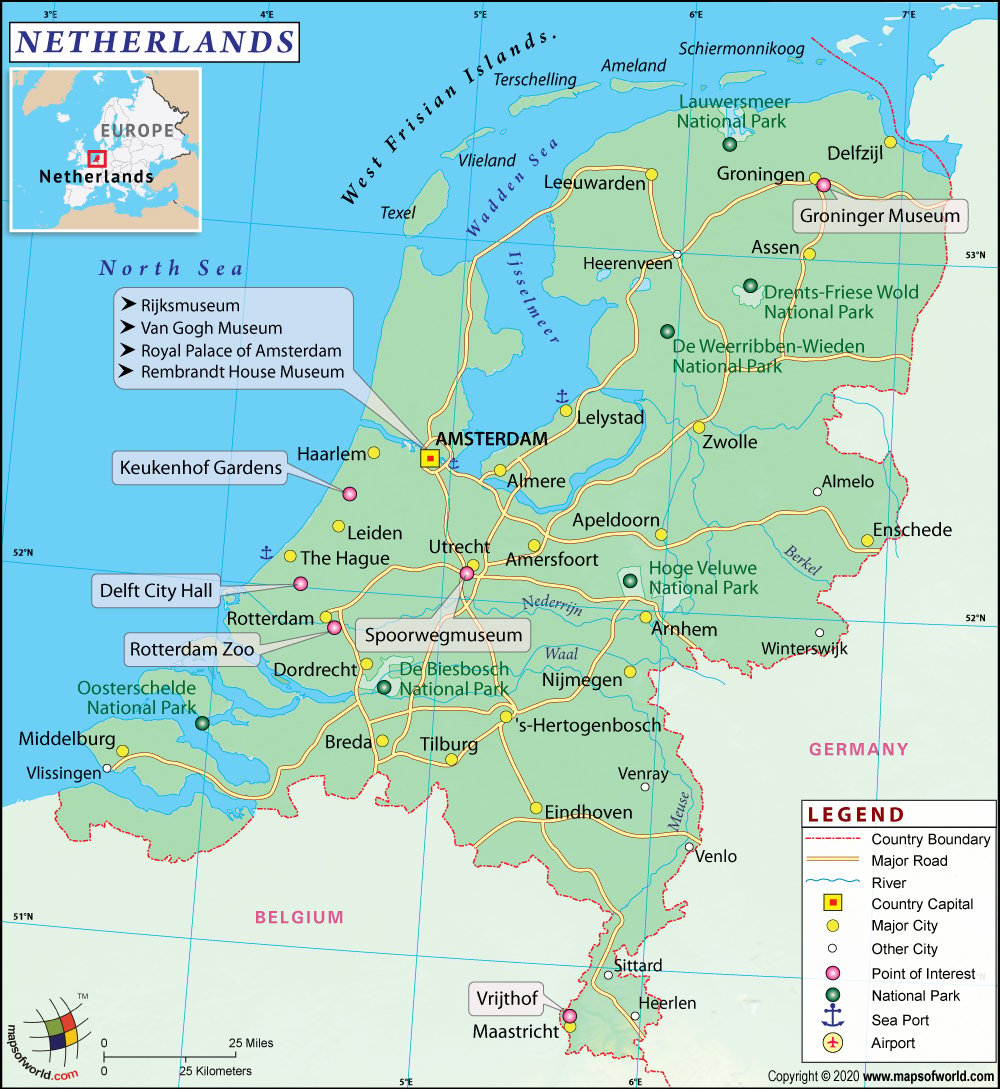
- Neighboring Countries - Belgium, Luxembourg, Germany, France, United Kingdom
- Continent And Regions - Europe Map
- Other Netherlands Maps - Where is Netherlands, Netherlands Blank Map, Netherlands Road Map, Netherlands Rail Map, Netherlands River Map, Netherlands Cities Map, Netherlands Political Map, Netherlands Physical Map, Netherlands Flag
About Netherlands
Explore this Netherlands map to learn everything you want to know about this country. Learn about Netherlands location on the world map, official symbol, flag, geography, climate, postal/area/zip codes, time zones, etc. Check out Netherlands history, significant states, provinces/districts, & cities, most popular travel destinations and attractions, the capital city’s location, facts and trivia, and many more.
| Official Name | (Kingdom of The Netherlands) Koninkrijkder Nederlanden |
| Capital | Amsterdam |
| Population | 16.6 million (2011 Estimate) |
| Area | 41,848 sq km or 16,158 sq mi |
| Currency | Euro |
| Religion | Christianity |
| Literacy | 100% |
| Languages | Dutch |
| Major Cities | Amsterdam, Rotterdam, Utrecht |
| Climate | Temperate maritime climate |
A highly developed nation, The Netherlands in northwest Europe is home to a large number of multinational companies like Philips, ABN Amro Bank, ING Group, world’s third-biggest oil company Shell, to name a few.
Physical Map of The Netherlands
The Netherlands is a low-lying country with half of the country’s landmass tucked away below sea level. Much of the western part that is below sea level is covered with clay and peat soils, lined with canals, rivers, and portions of the sea. Towards the east, the land lies slightly above sea level and is flat in nature. The elevation rarely exceeds 160 feet. The county is split into two major portions by three long rivers, the Rhine (Rijn), flowing from Germany, and its two tributaries, the Meuse (Maas) and the Waal. The Nederrijn river, the Scheldt (Escaut) river (flowing from Belgium), and IJssel river are the other major rivers of the country.
Location of The Netherlands
The Netherlands is bordered by the North Sea to the north and west, by Germany to the east, and by Belgium to the south. It also shares maritime boundaries with Germany, Belgium, and the United Kingdom. While the country forms the Low, or Benelux countries with Belgium and Luxembourg, Netherlands Antilles and Aruba, islands in the Caribbean form part of The Netherlands.
Flag of The Netherlands
The flag of The three equal horizontal bands of red (top), white, and blue; similar to the flag of Luxembourg, which uses a lighter blue and is longer; one of the oldest flags in constant use, originating with William I, Prince of Orange, in the latter half of the 16th century
Climate of Netherlands
As The Netherlands has high mountains, the climate varies a little from one region to another. Overall, it has a temperate maritime climate with cool summers and pleasant winters. The average temperature in the coastal region of Vlissingen ranges from 1° to 5°C in January to 14° to 21°C in July. In the densely populated central region of the country – De Bilt, the average temperature ranges from -1° to 4°C in January to 13° to 22°C in July. Annual rainfall averages 690 mm in Vlissingen and 770 mm in De Bilt. Cloudless days are uncommon, as is prolonged frost. The annual average temperature is close to 10°C and the average yearly rainfall is 76.5 cm.
Flora and Fauna of Netherlands
The country has scarce vegetation as the land has been exploited to a great extent by the people. Today, oak, beech, ash, and pine forests are preserved and managed well. The tall grasses of the dunes and the heather of the heaths continue to be the perfect home for rabbits, but larger wildlife, such as deer, have disappeared except in parks. Land reclamation projects of the country have created new habitats for many species of migratory birds.
The country is home to 20 national parks and over 100 natural reserves. Majority of them are held by Natuurmonumenten and Staatsbosbeheer. These parks and natural reserves are made up of heathland, water bodies, sandbanks, forests, and other locales.
People of The Netherlands
Majority of the inhabitants of The Netherlands are Dutch, who are basically the descendants of Franks, Frisians, and Saxons. The official language is Dutch, which is spoken throughout the country. However, most residents of Friesland Province are Frisian, a distinct cultural group with its own Germanic language and Frisian as its first language. Roman Catholics constitute 34 percent and Protestants 27 percent of the Dutch population. Followers of Islam make up for 4 percent of the inhabitants. Apart from this, the country also has a small Jewish community. Some 34 percent of the people do not belong to a religious body.
Economy of The Netherlands
The Netherlands has a very strong economy and has been playing a special role in the European economy for many centuries. Since the 16th century, shipping, fishing, trade, and banking have been leading sectors of the Dutch economy. The Netherlands is one of the world’s 10 leading exporting countries. Foodstuffs form the largest industrial sector. Other major industries include chemicals, metallurgy, machinery, electrical, goods and tourism.
Since the independence of Indonesia in the late 1940s, the Dutch economy has been redirected from colonial trade to that with the European nations. This led to the country becoming a major energy exporter as large deposits of natural gas were discovered. The national government has played a major role in the country’s growth, especially through its economic planning. The government’s influence is great and it distributes nearly half the Dutch national income. But also important in the economic growth of The Netherlands are the activities of a number of large private firms.