Maldives Map
 Buy Printed Map
 Buy Digital Map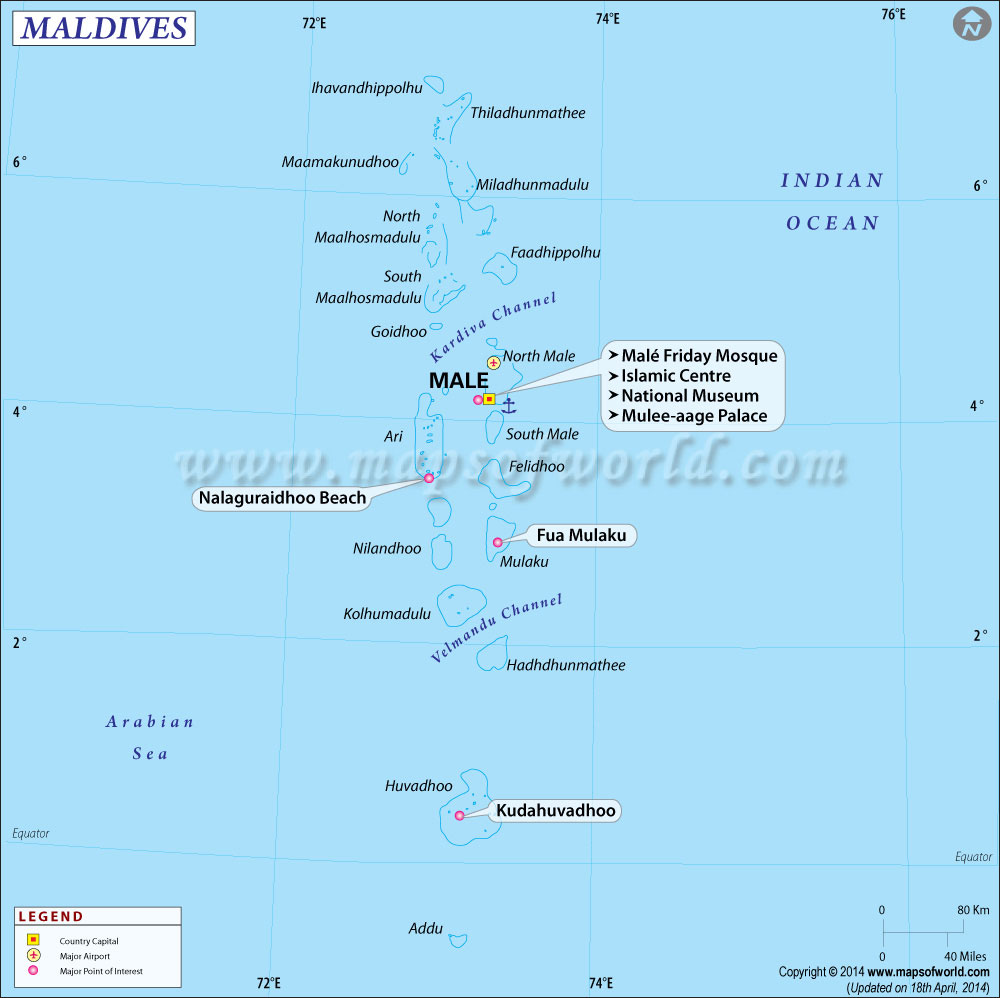
- Neighboring Countries - India, Sri Lanka
- Continent And Regions - Asia Map
- Other Maldives Maps - Where is Maldives, Maldives Blank Map, Maldives Flag
About Maldives
Explore this Maldives map to learn everything you want to know about this country. Learn about Maldives location on the world map, official symbol, flag, geography, climate, postal/area/zip codes, time zones, etc. Check out Maldives history, significant states, provinces/districts, & cities, most popular travel destinations and attractions, the capital city’s location, facts and trivia, and many more.
| Official Name | Divedhi Raajjeyge Jumburiya(Republic of Maldives) |
| Capital | Male |
| Population | 300,000 |
| Area | 298 sq km or 115 sq mi |
| Currency | Rufiyaa (US $1=11.77) |
| Religion | Islam |
| Literacy | 93% |
| Languages | Divehi (Sinhalese dialect) |
| Major Cities | Male |
| Climate | Varied Climate |
The famous explorer Marco Polo referred to the Maldives as the ‘flower of the Indies,’ while the great traveler Ibn Batuta called her ‘one of the wonders of the world.’ The archipelago of Maldives has been a constant source of attraction to many tourists all over the globe.
Its golden beaches, washed by the azure waters of the Indian Ocean, are enticing to one who loves to venture into the sea.
Physical Map of Maldives
Each atoll is enclosed by a fringing coral reef that has a few deep, natural channels serving as entry points. Likewise, a protective coral reef surrounds each island. Most islands have a shallow lagoon, known in Maldivian as a villu.
The islands are very small and low-lying, many of which are no more than two meters above sea level. Common features include white sandy beaches and clear lagoons. The protective coral reef surrounding each island is also home to hundreds of species of tropical fish, countless shapes and sizes of coral seashells and all forms of marine life.
The islands are formed from the growth of coral over long-submerged mountain ranges. These are true coral islands, with no other forms of rocks or minerals visible or within easy reach. As a result, beaches are covered with white coral sand with no trace of yellow or black as seen anywhere else in the world. There are no hills, mountains or rivers in the Maldives. The islands are small, and the coral-based soil is poor in essential nutrients.
Location of Maldives
Maldives is a group of coral islands that stretch along the 73rd meridian between latitudes 0°42′ south and 8°10′ north. The shortest distance from the mainland of India is 350 km and from Sri Lanka 740 km. The islands lie in the northern Indian Ocean and the sea area is approximately 107,500 sq km. There are some 1,200 islands in the country, 202 of which are inhabited. The archipelago is 823 km long and 130 km at its greatest width. The islands are formed into 26 natural atolls but they are divided into 19 administrative regions, also known as “atolls.”
Flag of Maldives
The flag of Maldives is red with a large green rectangle in the center bearing a vertical white crescent; the closed side of the crescent is on the hoist side of the flag.
Climate of Maldives
Generally, the year is divided into two monsoon periods: the northeast monsoon or Iruvai lasts from December to March, which are the drier months; the southwest monsoon or Hulhangu lasts from April to November, which are wetter, with more storms and occasional strong winds. Daytime temperatures are about 28°C throughout the year. The humidity is slightly lower in the dry season but on most days, there is a cool sea breeze.
Flora And Fauna of Maldives
Though several of the bigger islands have an abundant growth of palm trees, there are others that have poor, sandy soil that supports only a few plants-bamboo, banana, mangroves, breadfruit trees, banyans, tropical vines and numerous coconut palms. The larger, wetter islands have small areas of rainforest. The main crops are limited to sweet potatoes, yams, taro, millet and watermelon, though in a few fertile islands citrus fruits and pineapples are grown as well.
Natural fauna is sparse-giant fruit bats, colorful lizards and the occasional rat. Domestic animals include cats, a few chickens, goats and some rabbits. The most exciting wildlife is under the water. Diving under the azure waters will enable one to see butterfly fish, angelfish, parrotfish, rock cod, unicorn fish, trumpet fish, blue-stripe snapper, Moorish idols, oriental sweet lips and more. Larger life forms, keenly sought by scuba divers, include sharks, stingrays, manta rays, turtles and dolphins.
People of Maldives
The origins of the Maldivians are lost in history. Archaeological finds indicate that the islands were inhabited as early as 1500 BC, and there are tales of a legendary people called the Redin, who may have been among the earliest of explorers. It is believed that Aryan immigrants from the Indian subcontinent established permanent settlements around 500 BC. The early Maldivians were probably Buddhists or Hindus migrating from the Indian subcontinent.
Today, Maldives is perhaps the only country with a hundred percent Sunni Muslim population. Islam was introduced around AD 800, and the moderate form practiced in Maldives has remained virtually unchanged. The main tribes are Singhalese, Dravidian, Arab and African. No other religion, except Islam, is permitted. Several ancient beliefs still survive; for example, islanders fear jinn’s-evil spirits that come from the sea, land and sky. These are blamed for everything that cannot be explained by religion or science. Dhivehi, an indigenous language, is spoken only in the Maldives. The script is called “Thaana.”English is the main language taught at schools. Most people in Male and tourist resorts speak English.
Economy of Maldives
The economy is based on three principal activities: fishing, tourism and shipping. Poor soil and lack of cultivable land limit agriculture. Traditional industries consist of local boat or dhoni building, handicrafts such as mat-weaving, jewelry-making and lacquer work. Export-oriented industries include tuna fish canning and manufacture of garments. However, a severe shortage of labor in the tourism sector has resulted in the decline of most of these industries. Tourism remains the major source of foreign currency and the dominant support for the economy.
Arts, Culture and Music of Maldives
The term bodu beru means a big drum, and lends its name to the famous music and dance form of Maldives. Tourist resorts organize performances of this dance for a local culture night, and it can be quite sophisticated and gripping. There are four to six drummers in a group, and the hum has distinct African influences. Contemporary local rock bands often perform at resorts where they do credible covers of the usual old favorites. Performing for a local audience, they may incorporate elements of bodu beru in their music, with lots of percussion and extended drum solos.
Though performances of traditional music and dance are not daily events, the Dhivehi culture is strong and adaptive despite various foreign influences, ranging from Hindi movies and Oriental martial arts, to Michael Jackson and Muslim fundamentalism. Western fashions, pop music and videos are visible in the capital, but on public occasions, the celebrations always have a distinctly Maldivian touch.