Kuwait Map
 Buy Printed Map
 Buy Digital Map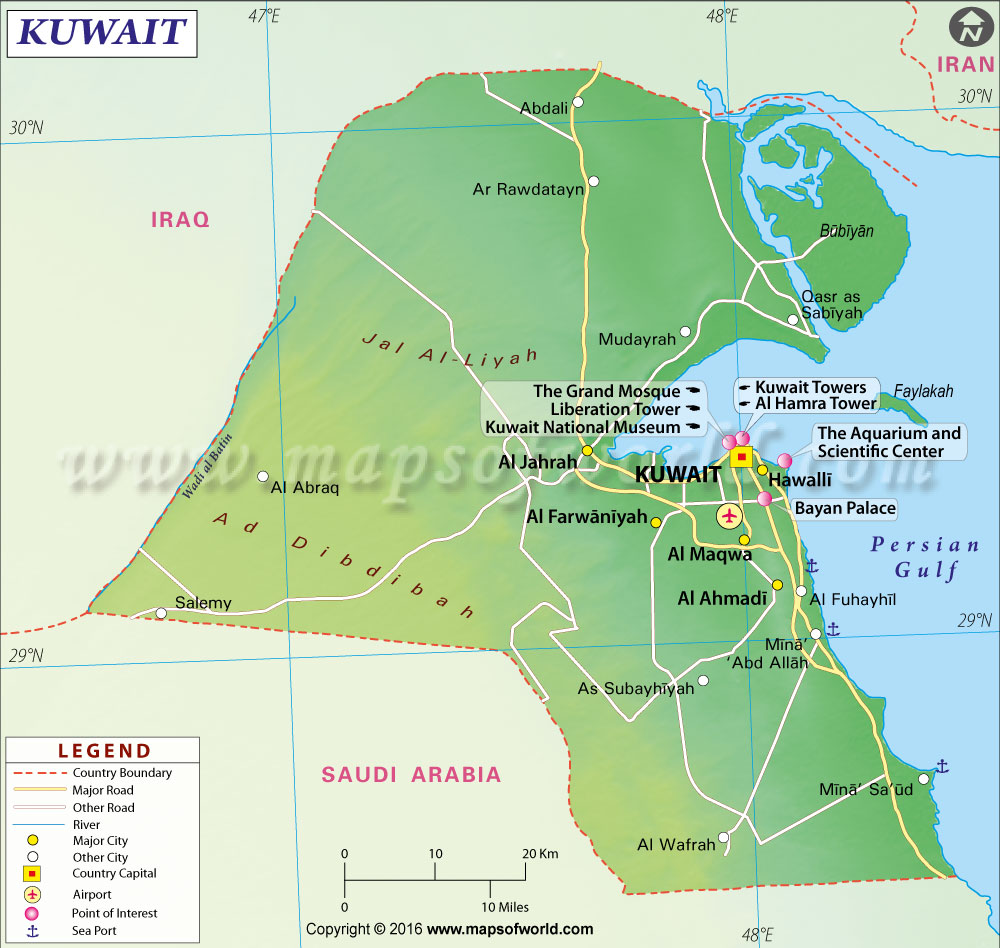
- Kuwait Cities - Kuwait
- Neighboring Countries - Iraq, Saudi Arabia, Iran
- Continent And Regions - Asia Map
- Other Kuwait Maps - Where is Kuwait, Kuwait Blank Map, Kuwait Road Map, Kuwait River Map, Kuwait Political Map, Kuwait Physical Map, Kuwait Flag
About Kuwait
Explore this Kuwait map to learn everything you want to know about this country. Learn about Kuwait location on the world map, official symbol, flag, geography, climate, postal/area/zip codes, time zones, etc. Check out Kuwait history, significant states, provinces/districts, & cities, most popular travel destinations and attractions, the capital city’s location, facts and trivia, and many more.
| Official Name: | Dawlat al-Kuwayt, (State of Kuwait) |
| Capital: | Kuwait City |
| Population: | 2.3 million (2001) |
| Area: | 17,818 sq km or 6,879 sq mi |
| Currency: | Kuwaiti Dinar ($ 1 = 0.31) |
| Religion: | Islam (official) |
| Literacy: | 79% |
| Languages: | Arabic (official) and English |
| Major Cities: | Hawalli, As-Salimiyah, Qalib ash-Shuyukh |
| Climate: | Hot and dry |
Kuwait, which means ‘little fort’, is an Islamic constitutional monarchy in southwestern Asia. On August 2nd 1990 Iraq invaded and annexed Kuwait, claiming it as its 19th province. This led to the Gulf War that liberated the country in 1991.
In November 1994, Iraq formally accepted the UN-demarcated border with Kuwait that had been spelled out in Security Council Resolutions made in 1991 and 1993.
Physical Map Of Kuwait
Kuwait is one of the world’s smallest countries, and the greatest distance from north to south is 200 km (120 mi) and from east to west is 170 km (110 mi). Most of Kuwait is made up of a flat sandy desert. Sans rivers or mountains, the sandy soil gradually slopes to sea level leading to coastal marshes, mud flats and salt depressions around the northern part of Kuwait Bay. Kuwait has beautiful sandy beaches along the Gulf. In the southwest, the landscape rises to a maximum elevation of 306 meters (1,004 feet).
Location Of Kuwait
Shaped roughly like a triangle, Kuwait is located at the northwestern tip of the Persian Gulf. It is bordered on the north and west by Iraq, on the south and west by Saudi Arabia, and on the east by the Persian Gulf.
Flag Of Kuwait
The Kuwait flag contains three equal horizontal bands of green (top), white, and red with a black trapezoid based on the hoist side.
Climate Of Kuwait
Although summers are long, hot, and mostly dry, with daily temperatures between 43º and 47ºC (110º and 120ºF) and high humidity in August, the fall and spring are pleasant and mild. Winters are short and relatively cool. Sandstorms and very hot northwesterly winds in June and July exaggerate the effects of the summer heat. Rainfall is scanty and some rain falls mainly in winter and spring.
Flora And Fauna Of Kuwait
Due to the low annual rainfall and the lack of surface water, plants and animal life in Kuwait have adapted to the arid conditions. During the late winter and early spring, especially after an abundant rain season, colorful desert flowers and grasses cover most of the land. Small mammals such as gerbils, hares, rabbits, and hedgehogs are common. Kuwait has also recorded approximately 300 species of birds. While only about 20 species can be found in Kuwait year long, many birds are winter visitors or passing migrants. They are attracted by the cool and wet winter months, which encourage insects and plants to flourish and thus create an ample supply of food.
People Of Kuwait
Most of the population is concentrated in cities near or along the Persian Gulf coast. Approximately 45 percent of the people are native Kuwaitis, while the remainder is foreign workers. Kuwait also has a significant population classified as bidun (Arabic for “without”), who are not citizens of any country. Among Kuwaiti citizens the population growth rate is very high, probably owing to Kuwait’s prosperity and high level of health care and social services. Nearly 50 percent of the population was younger than 25 years old in 1997.
Arts, Culture And Music Of Kuwait
But overtime, the oil earnings were used to make large investments abroad that brought down the dependency upon oil exports. Kuwait’s climate limits agricultural development. Consequently, with the exception of fish, it depends almost wholly on food imports. About 75% of potable water is required to be distilled or imported.
For a country of such small size, Kuwait boasts a very broad and rich culture, containing a particular heritage and encompassing certain trends whose roots are embedded in the cultural traditions of antiquity. Kuwait holds a strong tie to its past and many societal conditions seem to have stood the test of time. Some of these social rites include traditional Kuwaiti food, sports, and family life. Other aspects of society, such as national dress, have changed over time, and others, such as society’s leisure activities, seem to fluctuate with each generation. However, through everything that has changed, and with everything that has stayed the same, it is still possible to get a sense of a distinct national identity in Kuwait.
Economy Of Kuwait
Kuwait, a small and relatively open economy, is one of the world’s richest countries per capita. Its initial prosperity was based entirely on oil reserves, which is roughly one-tenth of the world’s total.