Denmark Map
 Buy Printed Map
 Buy Digital Map
 Wall Maps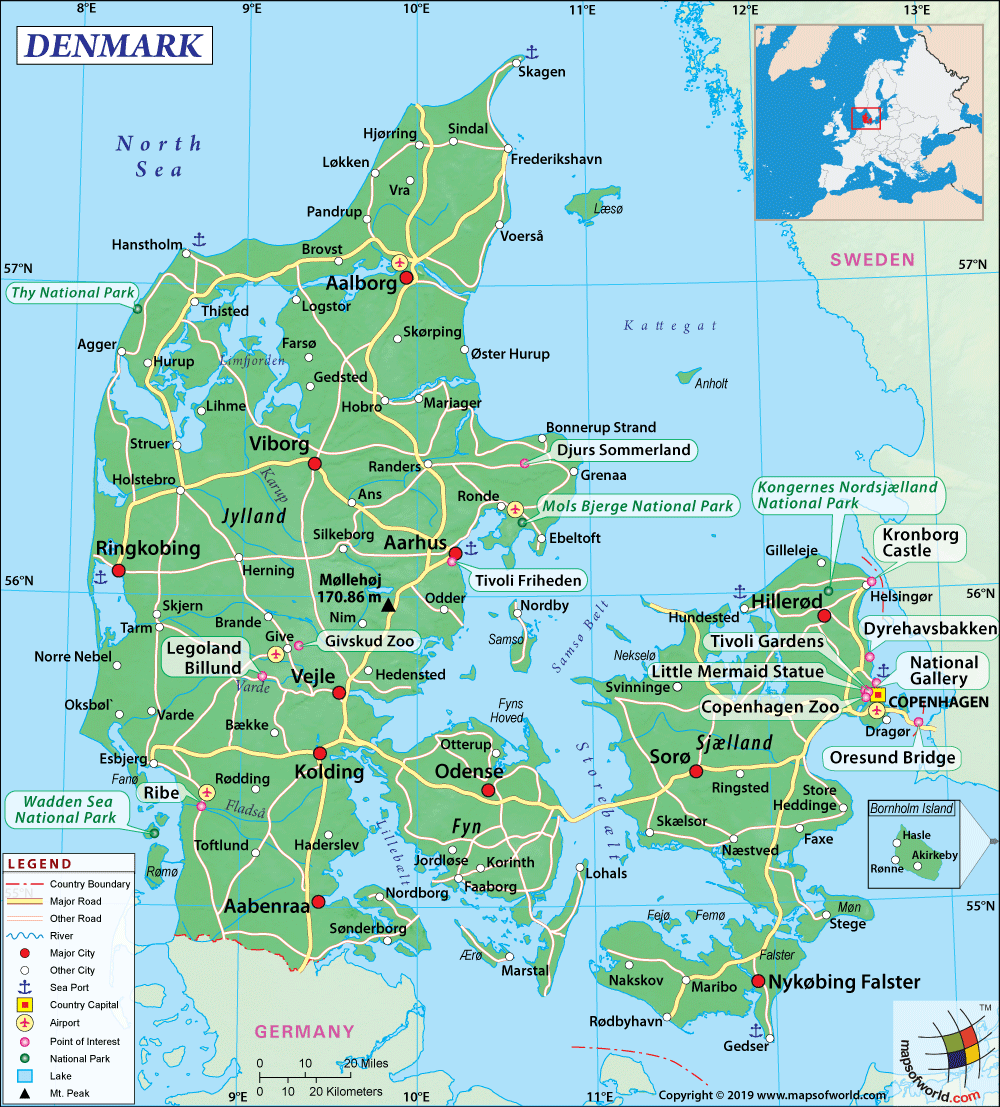
- Denmark Cities - Aalborg, Copenhagen, Odense
- Neighboring Countries - Germany, Poland, Norway, Sweden
- Continent And Regions - Europe Map
- Other Denmark Maps - Where is Denmark, Denmark Blank Map, Denmark Road Map, Denmark River Map, Denmark Political Map, Denmark Physical Map, Denmark Flag, Denmark Time Zone
About Denmark
Explore this Denmark map to learn everything you want to know about this country. Learn about Denmark location on the world map, official symbol, flag, geography, climate, postal/area/zip codes, time zones, etc. Check out Denmark history, significant states, provinces/districts, & cities, most popular travel destinations and attractions, the capital city’s location, facts and trivia, and many more.
| Official Name | Kingdom of Denmark (Kongeriget Danmark) |
| Capital | Copenhagen |
| Population | 5,671,050 |
| Area | 1,370,000 square miles |
| Currency | Danish Krone |
| Religion | Christianity |
| Literacy | 100% |
| Languages | Danish |
| Major Cities | Copenhagen, Odense, Alborg, Randers |
| Climate | Temperate maritime climate |
Denmark Bordered by Sweden to the south-west, Norway and Germany to the south, Denmark is the southern-most of the Nordic countries. It is located in northern Europe, bounded largely by the Baltic Sea and North Sea.
Copenhagen is the capital and the largest city.
Denmark is officially called the Kingdom of Denmark and comprises Denmark, Greenland, and the Faroe Islands.
Denmark covers a total area of 16,641 square miles. The surface of Denmark is made up of low-elevated land, with the average elevation just being 100 ft above sea level. A low range of hills in the east central portion of Denmark include Yding Skovhoj (568 ft), the highest point in Denmark. The western coast of the mainland is again low and bordered by dunes and sandbars. The east coast, which is slightly higher in elevation, is made up of a series of fjords that penetrate deeply into the interior.
According to the 2011 census, Denmark has an estimated population of 5,564,219. Ninety-seven percent of the Danes are ethnic Scandinavians, followed by Inuit, Faroese, and Germans.
Denmark has a temperate maritime climate. The mean temperature in summer is about 16°C and in winter, it is about 0°C. The day-today temperatures vary greatly because of the changes in the direction of the wind. The average annual rainfall is about 610 mm.
Copenhagen is the capital and the largest city. Situated on the islands of Zealand and Amager, it is one of the most eco-friendly cities in the world. The capital city is also the major cultural, administrative, and scientific center of Denmark.
Danish is the official language of Denmark spoken by the majority of the Danes. English and German are also spoken. The Constitution of Denmark recognises Danish National Church as the official state religion; it is a Lutheran Church. Islam and Judaism are also practiced.
History of Denmark
Denmark was initially dominated by the hunter gatherers before developing to a farming society. By the end of the the eighth century, Denmark was called Jutland. The area was ruled by the Vikings who raided most of the western Europe from the ninth to the eleventh century. Centuries later in 1520, the country was rocked by the Protestant Reformation.
The country plunged into many small battles in the years to come. In 1864, the Prussians and the Austrians attacked Denmark as an initial step in the unification of Germany.
Denmark remained neutral in the First World War but the Second World War changed the country’s economic and territorial stature. In 1953, Greenland officially became a territory of Denmark. On June 5, in the same year the constitution of the country was brought into force. This day is celebrated as the Constitution Day because it commemorates the anniversary of the signing of the constitution of 1849 and the constitution of 1953.
Denmark does not have a national day, but the country celebrates its Independence Day also on June 5.
Politics of Denmark
The Kingdom of Denmark is a unitary parliamentary democracy that functions in the framework of a constitutional monarchy. Queen Margrethe II is the ruling Monarch.
Denmark is divided into five regions and ninety-eight municipalities. The Central Denmark Region is the largest area in the country.
Flag of Denmark
The national flag of Denmark is red in color with a white Scandinavian cross. The cross stands for Christianity. The cross has also been adopted by the other Nordic countries like Sweden, Norway, Finland, Iceland and the Faroe Islands, as well as the Scottish archipelagos of Shetland and Orkney. The flag was used in the 1300s. Flora And Fauna of Denmark
Much of the land in Denmark is under cultivation. The forests which cover 10.7 percent of the country, include trees like conifers, beech, oak, birch, and ash. Several varieties of ferns and mosses, which are usually found in middle Europe are also found. The fauna of Denmark includes deer, other small mammals like the fox, squirrel, and hare. Numerous species of freshwater fish are also found in Denmark.
Arts, Culture and Music of Denmark
Denmark has a rich cultural heritage and has gained recognition across the world, be it in terms of literature, painting, music or artwork. Literature plays an important role in Danish culture and has produced many renowned writers. As far as music is concerned, the capital Copenhagen houses the Danish Radio Symphony Orchestra, Royal Orchestra, and the Royal Danish Ballet and a known name in this field is that of composer Carl August Nielsen, who was the conductor of the Royal Society and the Music Society in the late 19th and early 20th centuries.
Denmark is heavily into theaters and plays, which is often presented in The Royal Theater in Copenhagen. Besides this, the country is also famous for beautifully designed ceramics, silverware, porcelain, and home furnishings. Copenhagen has a permanent exhibition of arts and crafts where artisans from all over the country may display and sell their work.
Economy of Denmark
Though agriculture forms the base of economy in Denmark, manufacturing and services have also gained significance, especially by the end of the Second World War. Today, Danish ships which operate in foreign waters, contribute substantially to the economy. The country is also profitably involved in foreign investments, shipbuilding, and foreign construction. Denmark has the fifth-highest nominal GDP per capita. In 2010, the gross domestic product (nominal) of the country was estimated at $310.760 billion. Denmark has large reserves of oil and natural gas and is one of the net exporters of crude oil. Imported raw materials and foreign trade account for the heavy industrialised sector of the country. Germany, United States, Sweden, Norway, China, France, and the Netherlands are the major trading partners.
The krone denoted by the ISO 4217 code DKK is the official currency of the Kingdom of Denmark. It has been the national currency since January 1, 1875 and is subdivided into 100 øre. The krone is represented by the symbol kr.
Tourism is a significant part of the economy with Tivoli Gardens, Lego Land, Hans Christian Andersen’s House and Museum, and the Viking Ship Museum being the major attractions. Germany, United States, Sweden, Norway, China, France, and the Netherlands are the major trading partners.