Czech Republic Map
 Buy Printed Map
 Buy Digital Map
 Wall Maps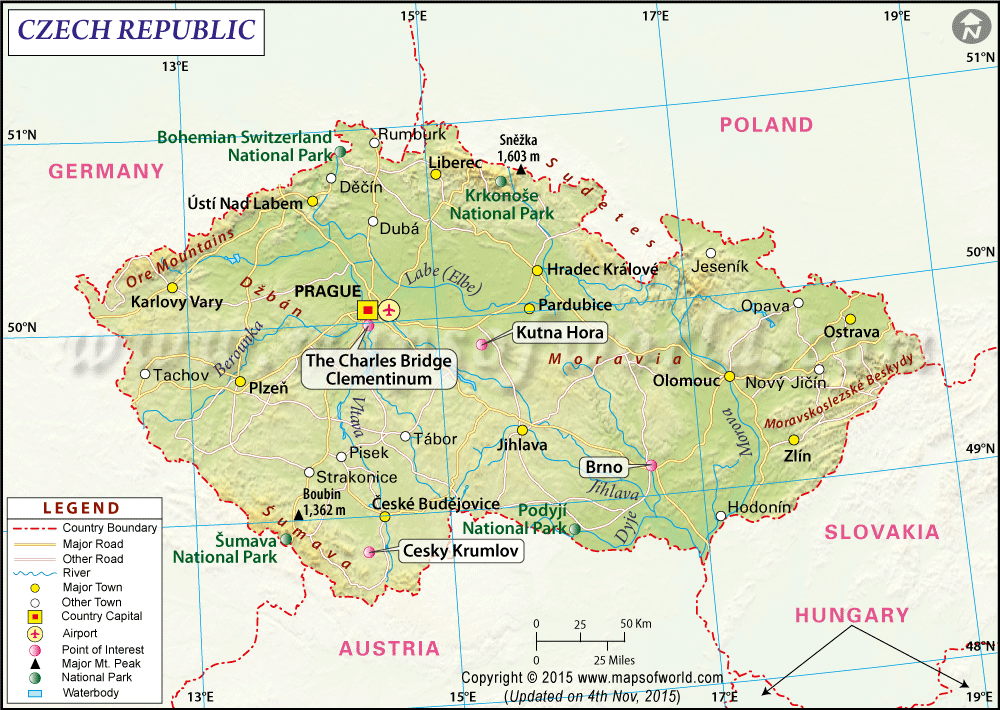
- Czech Republic Cities - Brno, Ceske Budejovice, Hradec Kralove, Jihlava, Karlovy Vary, Liberec, Olomouc, Ostrava, Pardubice, Plzen, Prague, Usti nad Labem, Zlin
- Czech Republic Regions - Cheb, Chrudim, Kadan, Kutna Hora, Liberec, Mlada Boleslav, Pribram, Rokycany, Trutnov, Usti nad Labem, Zdar nad Sazavou, Znojmo
- Neighboring Countries - Slovakia, Germany, Austria, Poland, Slovakia
- Continent And Regions - Europe Map
- Other Czech Republic Maps - Where is Czech Republic, Czech Republic Blank Map, Czech Republic Road Map, Czech Republic Rail Map, Czech Republic River Map, Czech Republic Political Map, Czech Republic Physical Map, Czech Republic Flag
About Czech Republic
Explore this Czech Republic map to learn everything you want to know about this country. Learn about Czech Republic location on the world map, official symbol, flag, geography, climate, postal/area/zip codes, time zones, etc. Check out Czech Republic history, significant states, provinces/districts, & cities, most popular travel destinations and attractions, the capital city’s location, facts and trivia, and many more.
| Official Name | Ceska Republic |
| Capital | Prague |
| Population | 10.3 million |
| Area | 78,864 sq km or 30,449 sq mi |
| Currency | The Koruna ($1=37.70) |
| Religion | Christianity |
| Literacy | 99% |
| Languages | Czech |
| Major Cities | Prague, Brno, Ostrava |
| Climate | Humid, continental climate |
Czech Republic, a landlocked country in Central Europe, gained independence on January 1 1993, when the Czech and Slovak Federal Republic (Czechoslovakia) was dissolved. Czech Republic MapThe country boasts of the world’s first beer museum, the first brewing textbook and some of the world’s best beers.
Physical Map of Czech Republic
Two main regions-Bohemia and Moravia make up the entire country. Bohemia is located in the west while Moravia is located in the east. Part of the region of Silesia occupies the north-central section of the country. The main rivers of the Czech Republic are the Elbe (known locally as the Labe), the Vltava, the Ohre, the Morava, the Luznice, the Jihlava, and the Svratka. The Sazava, Odra (Oder), and Opava few other important rivers.
Location of Czech Republic
Czech Republic is made up of the historic regions of Bohemia and Moravia, and part of Silesia. The country is bound towards the north by Poland, to the northwest and west by Germany, to the south by Austria, and to the east by Slovakia.
Climate of Czech Republic
The Czech Republic has a humid, continental climate, with cold winters and warm summers. The average temperature in Prague ranges from -5°C (22°F) to 0°C (33°F) in January and 12°C (53°F) to 23°C (74°F) in July. Temperatures generally decrease with increasing altitude. Prague receives an average annual rainfall of 530 mm. But it is usually the summer months that see the heaviest rains.
Flag of Czech Republic
The Czech Republic Flag has two equal horizontal bands of white at the top and red with a blue isosceles triangle based on the hoist side.
Flora And Fauna of Czech Republic
Czech Republic consists mainly of evergreen forest vegetation. The main deciduous trees are oaks, beeches, birches, poplars, and willows. Wildlife of the country includes rabbits, pheasants, deer, and boar.
People of Czech Republic
Around 94 percent of the population of Czech Republic is made up of Czechs, the dominant ethnic group of the country. The remaining six per cent is made of three percent of Slovaks and three percent of Poles, Germans, Roma (Gypsies), and Hungarians. It is a highly urbanized country with over 75 per cent of the people living in urban areas.
Arts, Culture and Music of Czech Republic
The country has a rich cultural heritage and has given the world some excellent artists. When it comes to music, the three main names that automatically comes to one’s mind are Bedrich Smetana, Antonin Dvorak, and Leos Janacek. Smetana wrote his major works in the late 19th century and based much of his music on Czech folk songs and dances. His famous opera The Bartered Bride (1866) provided a comic portrayal of Czech national life. Dvorak was also known for incorporating Czech folk music into his works. Janacek, whose career reached its height in the early 20th century, used the styles of Moravian folk music in the composition of his operas.
Economy of Czech Republic
Czech Republic is one of the most economically developed countries of Europe. In the year 1948, when the Communists came to power, they created a highly centralized economic system in which almost every aspect of economic planning and management came under the control of the central government. This economic policy followed a tradition of trading that took place only between the Communist countries. No doubt, following this tradition had the country boasting of a high standard of living in comparison to other European countries then, but in the long run it led to an economic decline. As the Communist regime collapsed in 1989, the subsequent government took reform measure to save the situation. The new economic policy privatized most of the firms and business boomed in the major cities of the country. So the declining economy soon began to recover and in late 1994, inflation was about 10 percent, less than half of what it was in 1991. Gross domestic product (GDP) increased by approximately 2 percent in 1994. Industrial production, which declined sharply in 1990 and 1991, also grew in 1994. The country’s foreign debt has remained modest. By 2001 the GDP had reached $56.8 billion.