Belgium Map
 Buy Printed Map
 Buy Digital Map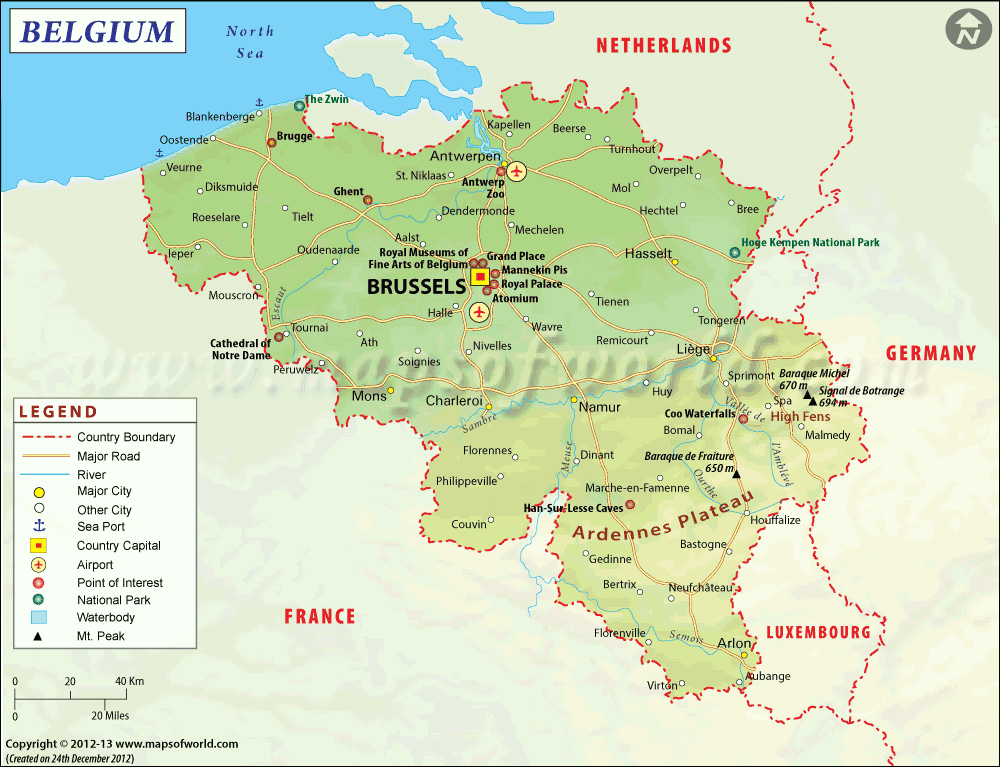
- Belgium Provinces - Antwerp, East Flanders, Hainaut, Liege, Limburg, Luxembourg, Namur, West Flanders
- Neighboring Countries - Luxembourg, Germany, Netherlands, France, United Kingdom
- Continent And Regions - Europe Map
- Other Belgium Maps - Where is Belgium, Belgium Blank Map, Belgium Road Map, Belgium Rail Map, Belgium River Map, Belgium Cities Map, Belgium Political Map, Belgium Flag
About Belgium
Explore this Belgium map to learn everything you want to know about this country. Learn about Belgium location on the world map, official symbol, flag, geography, climate, postal/area/zip codes, time zones, etc. Check out Belgium history, significant states, provinces/districts, & cities, most popular travel destinations and attractions, the capital city’s location, facts and trivia, and many more.
| Name | Kingdom of Belgium |
| Continent | Europe |
| Capital | Brussels |
| Independence declared from The Netherlands | July 21,1831 |
| Recognized | April 19,1839 |
| Area | 11,787 sq miles |
| Population | 11,007,020 (2011 estimate) |
| Major Languages | Dutch, French and German |
| Major Religions | Roman Catholic (75%) and others |
| Major Ethnic Groups | Flemish and Walloon |
| Form of Government | Federal Parliamentary Constitutional Monarchy |
| Country Code | 32 |
| Time Zone | Central European Time |
| Currency | Euro |
| GDP (PPP) | $ 413.281 billion (2011 estimate) |
| Literacy Rate | 99.00% |
| Human Development Index Rank | 18 |
The Kingdom of Belgium is located to the north-western part of Europe. It is bordered by France, Luxembourg, Germany, and the Netherlands. It and has a coastline along the North Sea. It is a densely populated country of 11,007,020 people (2011 estimate) and the major ethnic groups are Flemish, Walloon, and German. The various regions in the country are – Flanders in the north, Wallonia in the South, and Brussels which is located centrally. Belgium has a temperate maritime climate with cool summers, mild winters, and rainfall throughout the year.
Belgium, the most densely populated country in Europe, became a Federal State only in February 1993. The country is heavily into exports, in fact, around 50 per cent of the produce generated is exported. Belgium has to its credit the world’s 4th largest port, Antwerp, and also the world biggest diamond-trading center.
Physical Map of Belgium
Belgium can be divided into three regions – the coastal plain, the central plateau, and the Ardennes highlands. The coastal plain extends inland 16 to 48 km on the northwest. The central plateau is a slightly elevated area, made up of a number of wide, fertile valleys with a rich, alluvial soil. In this region, one can find caves and ravines too.
Historic Background
Belgium was a part of the Roman province of Gallia Belgica along with Netherlands and Luxembourg (commonly called Low Countries). After the collapse of the Roman Empire, this region came under the control of the Merovingian dynasty and Carolingian Empire in the 5th and 8th centuries respectively. In 843, the Treaty of Verdun divided the region into Middle and West Francia. These regions got further divided into small fiefdoms which were unified in the 14th and 15th centuries. In the 1540s, the land came under the control of King Charles V and following the Eighty Years War (1568-1648) it was divided into the northern United Provinces and Southern Provinces. It is the Southern Provinces which is known as Belgium today. Belgium was ruled by the Spanish and Austrian Habsburg dynasties successively and was the center of action during the Franco-Spanish and Franco-Austrian wars in the 17th and 18th centuries. After the French Revolution, the Low Countries were ruled by the first French Republic and after the fall of the First French Empire in 1815, they were unified to form the United Kingdom of Netherlands.
On July 21, 1831, Belgium led by King Leopold I declared its independence from Netherlands and at present, it is a constitutional monarchy with parliamentary democracy. Belgium was under German occupation during both the world wars. Belgium was also a colonial power and had colonial control over the Congo Free State or Belgian Congo. In 1960, during the Congo Crisis, Belgian Congo became independent. Currently, Belgium is passing through a strained phase due to the antagonism between its Flemish and Walloon groups.
The Ardennes highlands consist of densely wooded plateau averaging 1,500 ft in elevation, extending across southeastern Belgium and into northeastern France. The area is generally rocky and poorly suited for agriculture. The chief rivers flowing throughBelgium include the Schelde (Escaut) and the Meuse, which rise in France and are for the most part navigable throughout the country.
The people of Belgium can be divided into two ethnic groups – the Flemings, who are of Teutonic origin and the Walloons, who are of Celtic origin. These two groups can be distinguished on the basis of the languages they speak- the Flemings speak Dutch while the Walloons speak French.
Around 97 per cent of the population lives in urban areas even as the capital, Brussels, serves as home to a number of foreign guests.
Location of Belgium
Belgium is located in northwestern Europe, bound by The Netherlands and the North Sea in the north, Germany and Luxembourg in the east, and by France in the south and southwest.
Government
Belgium is a constitutional monarchy with parliamentary democracy in a federal structure.
- The King is the monarch and constitutional head of the state
- The federal parliament is bicameral and is composed of the Senate and the Chamber of Representatives. The members of the latter are elected by citizens of Belgium following the proportional voting system. Voting in Belgium is compulsory.
- The King appoints the Prime Minister and the Council of Minister who enjoy the confidence of the Chamber of Representatives. The Council of Ministers cannot exceed 15 members and as is usually composed of equal numbers of French speaking and Dutch speaking members.
- The Judicial system has its origin in Napoleonic Code and is based on civil law. The Court of Cassation modeled on the Cour de cassation of the French is the court of final appeal.
Flag of Belgium
The flag of Belgium is made up of three equal vertical bands – black towards the hoist side, yellow in the middle and red towards the right. The design of this flag is based on the flag of France.
Climate of Belgium
The climate of Belgium is mixed in nature, with areas near the sea experiencing humid and mild climate, while the inland sees a marked increase in temperature. Ardennes highlands has hot summers and cold winters. The months of April and November are considered to be rainy months even as heavy rains remain confined almost exclusively to the highlands. Fog and drizzle are also a common feature during this time.
Flora And Fauna of Belgium
The flora of Belgium is made up of plants like hyacinth, strawberry, goldenrod, periwinkle, foxglove, wild arum, and lily of the valley. Forest trees include oak, beech, elm, and stands of pine that have been planted as part of reforestation programs. The fauna is made up of small animals, primarily fox, badger, pheasant, squirrel, weasel, marten, and hedgehog. The Ardennes highlands is home to deer and wild boar.
Arts, Culture and Music of Belgium
Belgium has a rich cultural heritage and is well known for its art, architecture, music, food, and festivals.
The artistic legacy of Belgium is evident in the works of masters like Rubens and Boch and by its influence on European art. Music plays a prominent role in Belgian life and Belgian music is a heady mix of Flemish, Walloon, and German musical traditions. Belgium is also known for its various carnivals and parades which form an important part of Belgian cultural life. Food too is very important to the Belgians and its cuisine has been influenced by the traditions of different communities who call Belgium their home. But today a composite Belgian culture is far from reality due to the antagonism between the Flemish and the Walloon, with each group jealously trying to maintain their cultural distinctiveness which is apparent in every aspect of cultural life.
Belgian art has been influenced by major artistic movements in Europe from Renaissance to Impressionism. This country has produced artists of great caliber whose works have been admired and styles followed. Rubens, Boch and Van Dyck are a few of the many notable Belgian painters. Belgium is also famous for its architecture and its castles and monuments bear testimony to Romanesque, Renaissance, Gothic, and Baroque influences.
Belgian music is the melting pot Flemish, Walloon and German musical traditions and it forms an integral part of Belgian life. Some famous Belgian musicians are Adolphe Sax (inventor of saxophone), Eugene Ysaye, and Vieuxtemp.
Belgium is famous for its numerous carnival and parades. The well known Carnival of Binche features in the UNESCO’s list of Masterpiece of the Oral and Intangible Heritage of Humanity. Belgians are also very fond of comics and Belgian comics have influenced the comic book tradition in Europe. The world famous Tintin is a Belgian!!!
Economy of Belgium
Belgium’s central location in Europe and its well-connected transport system have been instrumental in developing the economic might of the country. Belgium was one of the first European nations to adopt industrialization and is currently one of the most industrialized countries in the world. The services sector is the driving force of the Belgian economy and the country boasts of a skilled work force. One of the founding members of the European Union, Belgium is an avid supporter of the open market. The major items of import are raw materials, oil products, machinery, transportation equipment, chemicals, pharmaceuticals, and diamonds; Belgium mostly exports machinery and equipment, food, finished diamonds, metals and metal products, and chemicals. Although Belgium has an enviable GNP and ranks high in the HDI index, the economic disparity between the Flanders and Wallonia regions and high instance of public debt (99% of GDP) is a matter of concern. Investors also fear that the country which was affected by the 2008 subprime crisis may not be able to withstand the Eurozone crisis.
Law and Order
Belgium as a whole and the rural zone of the country in particular, is considered quite safe. Major cities like Brussels and Antwerp that have witnessed incidences of crime, but the crime rate is pretty low when compared to most other countries. Belgium abolished capital punishment for both peace time and war time crimes way back in 1996.
People, Religion and Ethnic Groups
Belgian population can be mainly divided into the Dutch speaking Flemish (59%), the French Speaking Walloon (40%), and a minority German speaking population. There are also many non-Belgian communities living in the country. Roman Catholicism is the dominant religion with 75% of the population following this faith. Protestantism, Orthodoxy, and Anglicanism are also practiced. Besides Christianity, Belgium officially recognizes Judaism and Islam.
Sports
Football is the most popular sport in Belgium. Cycling is popular too and Belgian cyclist Eddy Merckx is considered as one of the greatest cyclist of all times. Belgium is also home to tennis stars like Kim Clijsters and Justine Henin. Belgians have also made their mark in swimming and judo. Formula One racing is also gaining popularity and Belgian Grand Prix is an important event in Formula One calendar.
National Holidays and Festivals
Belgium has over twelve public holidays. Some important public holidays are New Year’s Day (January 1), Easter, Labor Day (May 1), National Holiday (July 21), Armistice Day ( November 11), and Christmas ( December 25).
Though a secular country, the population of Belgium is mostly Christian and all festivals associated with this religion are celebrated with devotion and enthusiasm. Apart from these, some important Belgian festivals are Ommegang Festival in Brussels, Carnival of Binche in Binche, Statevelot in Stavelot and Zinneke Parade in Brussels.
In the early 1990s a growing budget deficit, combined with high unemployment rates, hindered Belgium’s overall economic growth. To reduce its deficit, the government initiated an austerity program that cut spending while raising taxes, as well as beginning a program to transfer some state-owned enterprises to the private sector. The budget in 1998 anticipated revenues of $109.5 billion and expenditures of $114.4 billion. Gross domestic product in 2001 totaled $229.6 billion.