Argentina Map
 Buy Printed Map
 Buy Digital Map
 Wall Maps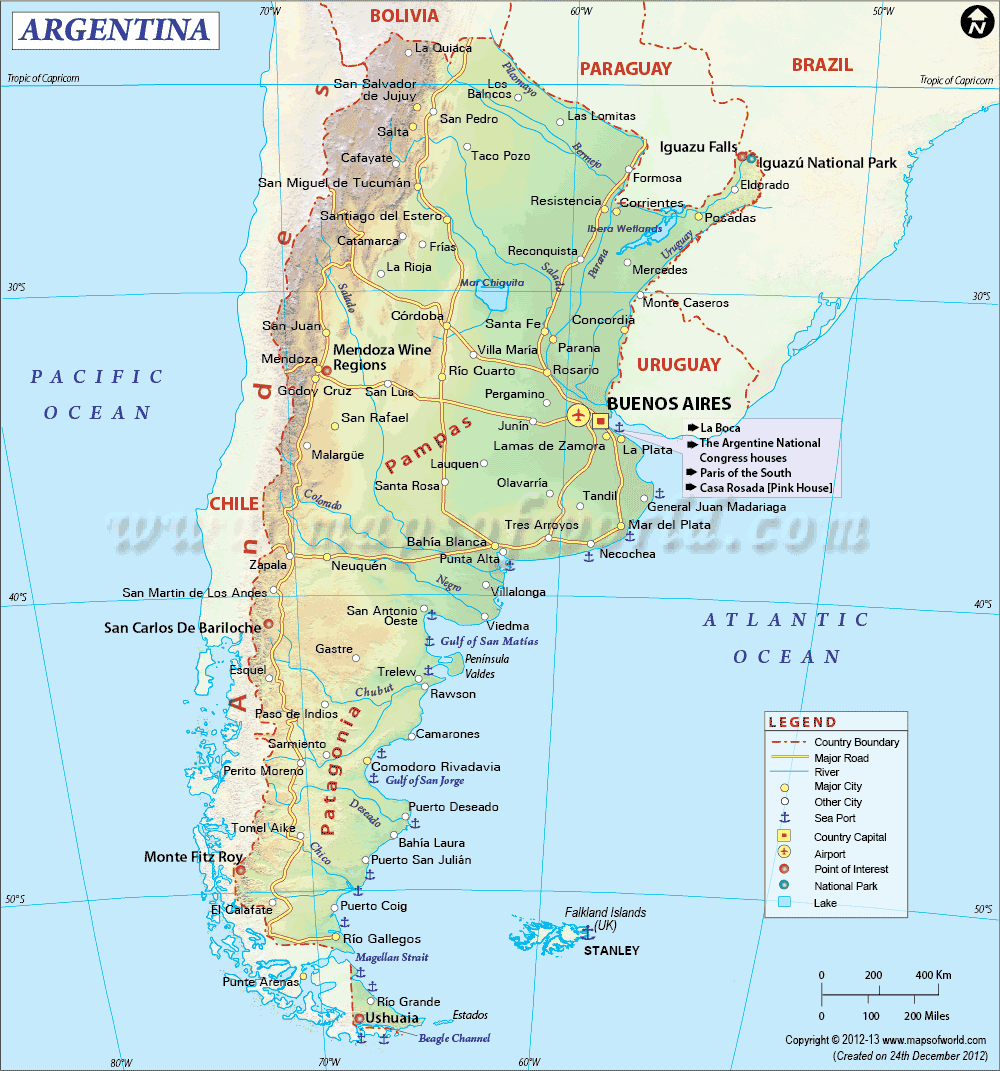
- Argentina Provinces - Buenos Aires, Catamarca, Chaco, Chubut, Córdoba, Corrientes, Entre Ríos, Formosa, Jujuy, La Pampa, La Rioja, Mendoza, Misiones, Neuquén, Río Negro,Salta, San Juan, San Luis, Santa Cruz, Santa Fe, Santiago del Estero, Tierra del Fuego, Tucumán
- Neighboring Countries - Bolivia, Brazil, Chile, Paraguay, Uruguay
- Continent And Regions - South America, Americas
- Other Argentina Maps - Where is Argentina, Argentina Blank Map, Argentina Political Map, Argentina Road Map, Argentina River Map, Argentina Railway Map, Argentina Physical Map, Argentina Flag
Explore this Argentina map to learn everything you want to know about this country. Learn about Argentina location on the world map, official symbol, flag, geography, climate, postal/area/zip codes, time zones, etc. Check out Argentina history, significant states, provinces/districts, & cities, most popular travel destinations and attractions, the capital city’s location, facts and trivia, and many more.
| Official Name: | Republica Argentina (Argentine Republic) |
| Capital: | Buenos Aires |
| Population: | 37,487,000 |
| Area: | 2.76 million sq km or 1.06 million sq mi |
| Currency: | Peso (US $1=3.44) |
| Religion: | Roman Catholicism (official) |
| Languages: | Spanish (official), Italian |
| Major Cities: | Buenos Aires, Cordoba, Rosario, Mar del Plata, La Plata, Mendoza |
| Climate : | Mostly temperate |
Argentina, the second largest country in South America with a stunning natural beauty has been, in the past few years, mired in serious economic problems.
But this had not deterred the tourists from all around to visit the country. Apart from being the world’s largest source of tannin, Argentina also possesses rich natural resources.
Where is Argentina
Argentina is situated in the southern part of South America, bordering the South Atlantic Ocean, between Chile and Uruguay.
Physical Map of Argentina
Argentina is made up of rich plains of the Pampas in northern half, flat to rolling plateau of Patagonia in south. The borders are defined by the Andes Mountains and Chile to the west, the Atlantic Ocean in the east, and the borders of Uruguay, Brazil, Bolivia, and Brazil to the north. The country covers over 1,000,000 square miles, as the west coast of the United States.
Climate of Argentina
The climate of Argentina is overall temperate in nature while being arid in southeast and subantarctic towards the southwest. The south has very low temperatures while the north and central part experience hot and moderate temperatures respectively.
Flora And Fauna of Argentina
Argentina comprises of varied kind of vegetation owing to different climate conditions. The country has tropical plants like palm, rosewood, etc as well as drought resistant trees like eucalyptus, sycamore, and acacia. Grasses, herbs, shrubs, and brambles too dot various parts of Argentina. As far as fauna is concerned, monkeys, jaguars, pumas, ocelots, anteaters, and raccoons are found in Argentina while birds include the flamingo and various hummingbirds and parrots.
History & Political Map of Argentina
As history shows, the year 1536 saw Pedro de Mendoza, a Spanish soldier appointed as the military governor of all land in South America, south of the Rio de la Plata, establish Buenos Aires but soon they had to abandon it in 1541 as they were faced with terrible hardships. Buenos Aires was not successfully established until 1580, and remained a backwater for 200 years. Buenos Aires became the capital of the new Viceroyalty of the Rio de la Plata in 1776, proving the region had outgrown Spain’s political and economic domination. However, the growing dissatisfaction of Spanish interference led to a revolution on 25 May 1810, which eventually paved way to independence in 1816.
But independence again saw regional disparities and the country experienced periods of internal political conflict between conservatives and liberals and between civilians and military factions.
The first decades of the 20th century witnessed a weak civilian rule, though the country achieved greater prosperity from 1901 to 1913. Then in 1943, Argentina was led to a military coup, it was this year that also saw dictator Juan Peron rise to power.
However, his party was squashed by a military coup in 1955, leading to Peron’s banishment to Spain’s and initiating 30 years of military rule, interspersed by only brief periods of civilian rule. Peron returned to rule briefly in 1973, dying in office in 1974 and bequeathing power to his third wife, Isabel. Growing economic problems and political instability led to strikes, political kidnappings and guerrilla warfare. Isabel’s government fell in 1976, and the new military government instituted a reign of terror.
The years 1976 to 1980 saw a shaky, instable nation and in 1981 when a new military government took over, the economy of the country went in for more upheaval. This internal conflict came to an end only with the emergence of a ‘real’ war in the south Atlantic: the battle for the Malvinas/Falklands. Britain was the eventual ‘victor. Later, in June 1995, the Argentine foreign minister offered to buy the islands, offering each of the 2000 islanders some amount for their nationality.
In the year 2001, Argentina again underwent a spell of economic and political turmoil. In 2002, Eduardo Duhalde became Argentina’s fifth president in two weeks. Early 2003, in a Presidential election Nestor Kirchner become the president and he soon sprang into reform overdrive. By then, the protests had calmed down, the violence had for the most part eased and the stage of siege had been lifted.
People of Argentina
Argentina has 36,000,000 people with Roman Catholicism being the main religion. This is one Latin American country where Europeans and North Americans can really feel at home. Famous for its love for football, the locals adopt a foreigner into their group if he shows an interest in soccer and some nimble foot skills. Argentina is well known in the literary world too by having produced writers of international stature such as Jorge Luis Borges, Julio Cortázar, Ernesto Sábasto, Manuel Puig and Osvaldo Soriano.
Culture :
With heavy influence of various countries, Argentina has acquired quite a diverse culture – be it arts, crafts, music every segment will have traces of European touches mixed with British, Spanish, German cultures. But this is a country which is rich in cultural history and has flourishing traditions to boast about. One of the most popular cultures is the tango, a form of dance and music which is considered to be one of the most romantic ways of expressing love. Theatres also dominate the interests of most of the people here. Folk music is another form of entertainment in which the people of Argentina indulge in.
Argentina Flag
The flag of Argentina constitutes of three equal horizontal bands – light blue at the top and bottom and white in between. The white band has a radiant yellow sun with a human face known as the Sun of May in the center.
Economy of Argentina :
Though Argentina has rich natural resources and heavy deposits of coal, lead, copper, zinc, gold, it has been suffering from recurring economic problems in the past decade.
In the year 1989, when President Carlos Menem took office, the country had piled up huge external debts, inflation had reached 200% per month, and output was plummeting. To combat the economic crisis,the government embarked on a path of trade liberalization, deregulation, and privatization. In 1991, it implemented radical monetary reforms which pegged the peso to the US dollar and limited the growth in the monetary base by law to the growth in reserves. Inflation fell sharply in subsequent years. The government privatized most state-controlled companies, opened the economy to foreign trade and investment, improved tax collection, and created private pension and workers compensation systems.
As a result of these policies, Argentina experienced a boom in economic growth in the early 1990s, followed by a period of somewhat more erratic growth in the second half of the decade when the country was hit by a series of external economic shocks.
In 1995, the Mexican peso crisis produced capital flight, the loss of banking system deposits, and a severe, but short-lived, recession; a series of reforms to bolster the domestic banking system followed. Real GDP growth recovered strongly, reaching 8% in 1997. In 1998, international financial turmoil caused by Russia’s problems and increasing investor anxiety over Brazil produced the highest domestic interest rates in more than three years, halving the growth rate of the economy. Conditions worsened in 1999 with GDP falling by 3%.
President Fernando de la Rua, who took office in December 1999 following the 10-year administration of former President Carlos Menem, sponsored tax increases and spending cuts to reduce the deficit, which had ballooned to 2.5% of GDP in 1999. The new government also arranged a new $7.4 billion stand-by facility with the IMF for contingency purposes – almost three times the size of the previous arrangement. Key challenges facing the new government included reforming the country’s rigid labor code and addressing the precarious financial situation of several highly indebted provinces.